
Rounded shoulders means the tips of your shoulders sit forward of your trunk and roll inward. It is rarely a shoulder-only problem. It is what your whole upper body does when you lean toward a screen and reach for a keyboard and mouse for hours.
The most useful home check is a side-view photo. The well-known test of lying down to see whether your shoulders lift off the floor could not tell people with shoulder symptoms from people without them in a 2007 study.1
What rounded shoulders actually are
Your arm hangs from your shoulder blade, which glides over your rib cage. When your upper back rounds and your arms reach forward, the blade slides outward and tips forward, so the shoulder looks rolled in. Clinicians call this forward shoulder posture.
Researchers measure it on a side-view photo: the angle between a vertical line through the bony bump at the base of your neck (C7) and a line from that bump to the tip of your shoulder.2 There is no agreed cutoff. One study counted 46 degrees or more as rounded; another used 52.23
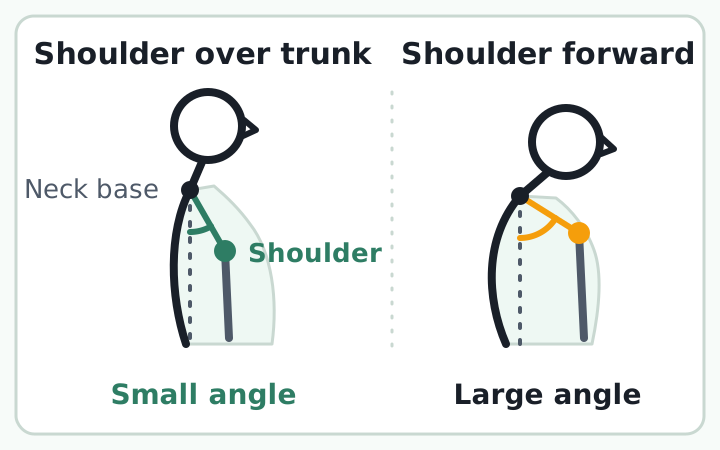
It is also common. When researchers in Philadelphia assessed 88 healthy adults aged 20 to 50, 73% had a rounded right shoulder and 66% a rounded left.4 The severity of the posture was not related to the severity or frequency of pain. People with more pronounced changes were more likely to report some pain, though, and rounded shoulders went along with pain between the shoulder blades.4
Rounded shoulders, forward head posture (tech neck), and a rounded upper back often appear together, but each can show up alone.5 See the forward head posture self-check and why sitting rounds your back.
Rounded shoulders causes: what upper crossed syndrome gets right and wrong
Search for causes and you will meet upper crossed syndrome, first described by Vladimir Janda.6 It says the chest and upper shoulder muscles get tight while the deep front neck muscles and the muscles between the shoulder blades get weak, forming an X when seen from the side.6 Parts of this picture have support. Parts do not.
| Common claim | What studies found |
|---|---|
| Tight chest muscles pull the shoulders forward | Muscle length was related to shoulder blade position7 |
| Weak back muscles let the shoulders roll in | No significant link between strength and shoulder blade position7 |
| Rounded shoulders cause impingement | 10 studies disagreed; no consistent posture was found8 |
| A rounded upper back causes shoulder pain | No significant difference in upper back curve between people with and without shoulder pain (moderate evidence)9 |
A 2014 systematic review co-authored by Jeremy Lewis of the University of Hertfordshire in the UK concluded that rehab aimed at returning the shoulder blade to an idealized normal posture is not supported by the literature. A position outside the norm, the authors noted, may simply be normal variation.8
Posture is not irrelevant. When 34 healthy adults sat slouched, they could raise their arm 23.6 degrees less on average, and strength with the arm held level dropped 16.2%.10 Whether that adds up to pain over the years is where the evidence is mixed.9
Rounded shoulders test: 4 self-checks and how far to trust them
Home checks show a tendency, not a diagnosis. The evidence behind each one differs, so start with the table.
| Self-check | What you look at | Evidence |
|---|---|---|
| Side-view photo | How far forward the shoulder tip sits | Used in research; the cutoff angle varies23 |
| Lying on your back | How far the shoulder lifts off the floor | 1-inch cutoff, but symptom-free people averaged about 6 cm1 |
| Standing against a wall | Whether the backs of your shoulders touch | We found no study of its accuracy |
| Hand position | Whether the backs of your hands face forward | We found no study of its accuracy |
The lying-down check began as the pectoralis minor length test. A textbook rule says that if the back of the shoulder tip sits more than 1 inch (2.54 cm) above the table, that small chest muscle has shortened.1 Lewis and a colleague measured 45 people with shoulder symptoms and 45 without. Both groups averaged about 6 cm, and every symptom-free person tested positive: 100% sensitivity, 0% specificity.1 The test could not separate people with a problem from people without one.
So floating shoulders alone are no reason to worry. Use the check to compare left with right, or now with a few months ago.
How to take a side-view photo
- Prop your phone at shoulder height, stand side-on, and use the timer.
- March in place, stop, and stand the way you normally do. Do not straighten up for the camera.
- Take a seated photo too, ideally snapped by someone else while you work.
- Draw a vertical line up from the bump at the base of your neck and see how far forward the shoulder tip sits. Repeat a month later.
5 desk habits that pull your shoulders forward
At a desk, your shoulders follow your hands. OSHA notes that a keyboard or mouse placed too far away makes you reach with your arms and lean forward with your torso.11 Five habits stand out.
| Habit | What happens | What to change |
|---|---|---|
| Keyboard too far away | You reach and your torso leans forward11 | Bring it in until your elbows rest near your sides |
| Mouse far out to the side | Your arm swings out and shoulder muscles work harder1215 | Park it right beside the keyboard |
| Forearms hovering | Your shoulders carry the weight of your arms | Rest forearms on the desk or armrests13 |
| Desk too high or too low | Too high and your shoulders hike up11; elbows below the keys were tied to more symptoms14 | Elbows at about keyboard height11 |
| Screen low or text small | You crane in, and your back and shoulders follow | Top of screen at or slightly below eye level19; enlarge text |
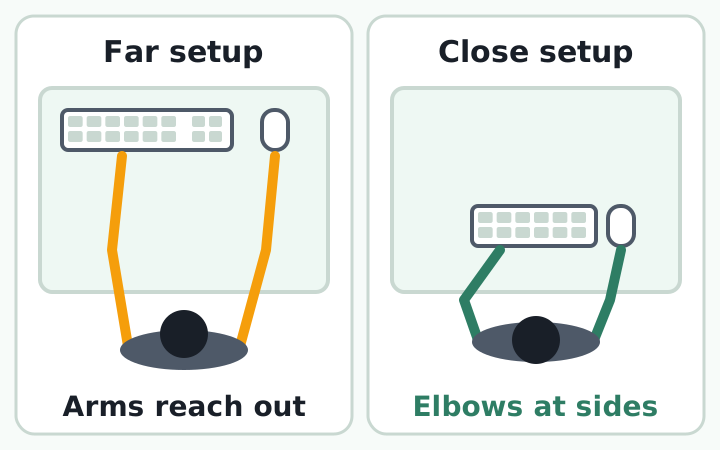
Keyboard: close enough that your elbows stay by your sides
OSHA recommends placing the keyboard directly in front of you, at a distance that keeps your elbows close to your body and your forearms roughly parallel to the floor.11 You do not need exactly 90 degrees at the elbow, though.
A team led by Michele Marcus at Emory University followed 632 newly hired computer users. Those who typed with a more open elbow angle (over 121 degrees) or had armrests had a lower risk of neck and shoulder symptoms, while typing with the elbows below the keys was linked to a higher risk.14 The study was observational, so it shows association, not cause.
Mouse: right beside the keyboard
The number pad pushes your mouse farther out than you think. In a lab study of 10 people, placing the mouse beside a keyboard with no number pad significantly lowered activity in the front and middle deltoid, the muscle that caps the shoulder. Trapezius activity did not change.12 The Canadian Centre for Occupational Health and Safety (CCOHS) notes that swapping an 18-inch keyboard for a 14-inch one frees up 4 inches beside it.16
Forearms: supported, not hovering
David Rempel's group at the University of California, San Francisco, randomized 182 call center operators to different workstation setups for a year. Those given a wide forearm support board had about half the rate of new neck and shoulder disorders (hazard ratio 0.49) and less neck and shoulder pain than the comparison group.13 It was a single company, and everyone also received ergonomics training.
You can apply the idea without a board: pull your chair in and rest your forearms on the desk or armrests. For heights, see how to set monitor, desk, and chair height.
On a laptop, the screen and keyboard cannot both be in the right place. For long sessions, raise the screen and add a separate keyboard and mouse.
How to fix rounded shoulders: what exercises and braces can do
A 2026 meta-analysis pooled 28 randomized trials (901 people) of corrective exercise for upper crossed syndrome.17 Exercise produced large changes in head, shoulder, and upper back angles. Its effects on pain, function, and muscle activity were inconclusive.17
Exercise can change the angle in your photo, but a better angle has not been shown to mean less pain. A 2010 review found that chest stretching could shift resting shoulder blade position, but it noted a shortage of high-quality studies and called for follow-up measurements to see whether the change lasts.7
Posture correctors are a popular search. In one brace study, the shoulder angle dropped when the straps were tightened, but the 38 participants were symptom-free athletes measured right after fitting.2 The study says nothing about pain, or about what happens once the brace comes off. For buying criteria, see what to check before buying a posture corrector.
Despite the absence of strong evidence to support these common beliefs, a large posture industry has flourished, with many interventions and products claiming to "correct" posture and prevent pain.
Slater et al., Journal of Orthopaedic & Sports Physical Therapy, 2019
That viewpoint was about spinal pain, but it fits the urge to pin your shoulders back all day.18 Changing position often is more realistic than holding one perfect position.
Shoulder pain has many causes besides posture, and posture alone often does not explain it.9 See a doctor if pain lasts more than a few weeks, wakes you at night, or comes with numbness, tingling, weakness, or trouble raising your arm.
One line to add to your routine: when you sit down, pull the keyboard and mouse in close before you start. It's the easiest habit in this post to begin today.
What outlasts "sit up straight": the habit of noticing
Rounded shoulders are common and do not, by themselves, mean pain. The lying-down test is a poor guide; a side photo and a look at your desk tell you more. Three things to check today:
- Are your elbows near your sides while you type?
- Is your mouse right next to your keyboard?
- Are your forearms resting on the desk or armrests?
One problem remains. Even with the keyboard pulled in, once you are absorbed in work your body drifts back toward the screen. You rarely catch the moment your shoulders roll in and your head moves forward. What you can do at a desk is build the habit of noticing that moment and resetting.
RightPose AI is a desktop app for Windows and Mac. At an interval you set (5 minutes by default), it uses your laptop or monitor webcam to take a brief look at your posture and shows an on-screen alert if your head has drifted forward. You register your own upright posture first, and the app judges against that baseline. When an alert appears, you see yourself on screen with joint lines drawn in and can reset your head, shoulders, and arms yourself.
It also reminds you to stretch and stand up, with stretches to follow along. Camera images are processed on your device and are not sent off it. RightPose AI is not a medical device. It is a habit tool that notices your posture and nudges you to reset and stretch.
If you're building a better daily routine, register your own good posture first and let the reminders do the noticing while you work.
FAQ
How long does it take to fix rounded shoulders?
There is no set timeline. Most trials ran exercise programs for a matter of weeks; one randomized trial of 36 office workers lasted 8 weeks.3 Few studies checked whether the change held after the program stopped.7 Pair any exercise plan with changes that stay in place, like where your keyboard and mouse sit.
Are rounded shoulders the same as tech neck or kyphosis?
No. Tech neck (forward head posture) describes where your head sits, rounded shoulders describes your shoulder tips, and kyphosis describes the curve of your upper back. A literature review found they can exist alone or in any combination.5 Among 88 healthy adults, 66% had forward head posture, 66% to 73% had rounded shoulders, and 38% had a rounded upper back.4
Should I pull my shoulders back all day?
There is no strong evidence that holding a braced posture wards off pain.18 Rehab aimed at putting the shoulder blade in an ideal position is not supported by current studies either.8 Moving your keyboard and mouse closer does some of the work for you, because your arms and torso no longer have to reach.11
When should I see a doctor about rounded shoulders?
Posture alone usually does not need medical care; it is common in healthy adults.4 See a doctor if you have pain or numbness that does not go away, weakness, or trouble lifting your arm, so that causes other than posture can be checked.
References
- The pectoralis minor length test: a study of the intra-rater reliability and diagnostic accuracy in subjects with and without shoulder symptoms
- Scapular bracing and alteration of posture and muscle activity in overhead athletes with poor posture
- Corrective exercises administered online vs at the workplace for pain and function in the office workers with upper crossed syndrome: randomized controlled trial
- Incidence of common postural abnormalities in the cervical, shoulder, and thoracic regions and their association with pain in two age groups of healthy subjects
- Association Between Forward Head, Rounded Shoulders, and Increased Thoracic Kyphosis: A Review of the Literature
- Upper Crossed Syndrome in the Workplace: A Narrative Review with Clinical Recommendations for Non-Pharmacologic Management
- Effectiveness of strengthening and stretching exercises for the postural correction of abducted scapulae: a review
- Is there a relationship between subacromial impingement syndrome and scapular orientation? A systematic review
- Is thoracic spine posture associated with shoulder pain, range of motion and function? A systematic review
- Thoracic position effect on shoulder range of motion, strength, and three-dimensional scapular kinematics
- Computer Workstations eTool: Workstation Components - Keyboards
- Influence of mouse position on muscular activity in the neck, shoulder and arm in computer users
- A randomised controlled trial evaluating the effects of two workstation interventions on upper body pain and incident musculoskeletal disorders among computer operators
- A prospective study of computer users: II. Postural risk factors for musculoskeletal symptoms and disorders
- Computer Workstations eTool: Workstation Components - Pointer/Mouse
- Office Ergonomics - Computer Mouse - Location - Beside Keyboard
- Corrective exercises strongly improve posture but fail to produce consistent clinical or functional benefits in patients with upper crossed syndrome: a systematic review and meta-analysis of randomized controlled trials
- "Sit Up Straight": Time to Re-evaluate
- Office ergonomics: Your how-to guide
This article is for general information only and is not a substitute for medical diagnosis or treatment. If pain persists or worsens, consult a medical professional.