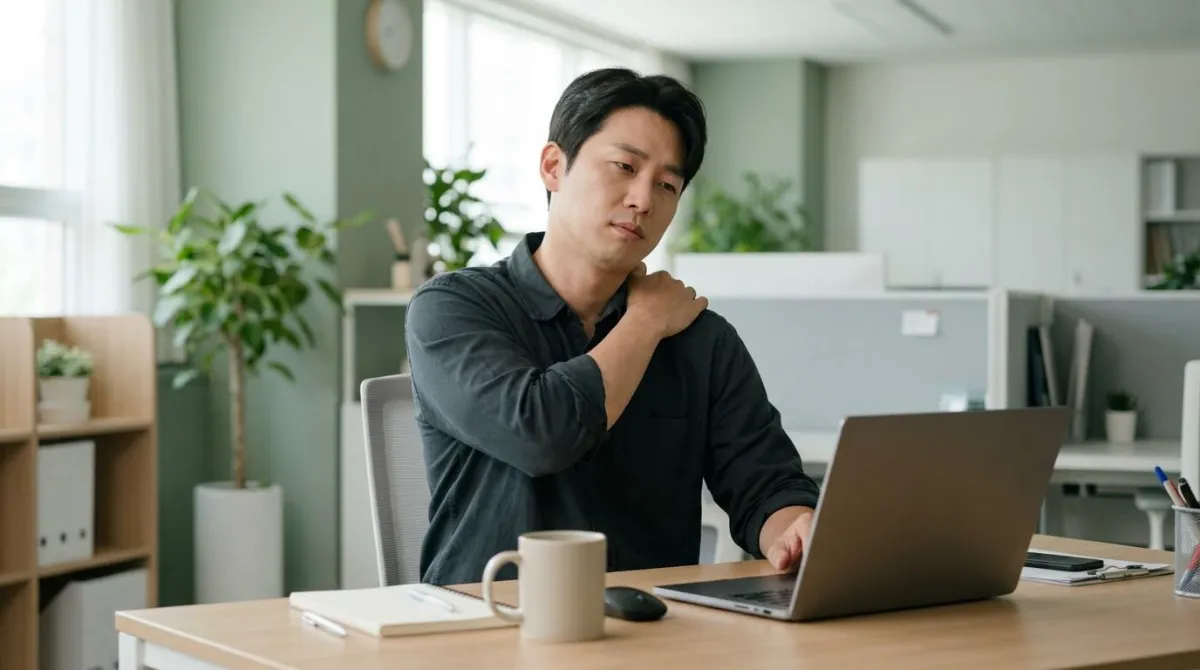
If your upper traps tighten up again a day after you stretch or massage them, the likely reason is not that they work hard. It is that they almost never switch off. In a full-workday study of 26 computer workers, the trapezius ran at just 0.9 to 1.8% of its maximum while people sat at their desks.3
This article explains why such a small effort can leave a muscle tight, what drives shoulder tension at a desk, and how strong the evidence is for massage, stretching, strengthening, and breaks. Where studies disagree, it says so.
What your upper traps do while you type
The trapezius is a large muscle that runs from the base of your neck across your shoulders and down to the middle of your back. It has upper, middle, and lower sections, and the upper section attaches to your skull and neck. It shrugs your shoulders, pulls them back, and moves your shoulder blade when you lift an arm.1
At a desk, the job is quieter. Your arms hover over the keyboard and mouse, and the upper traps hold your shoulder blades in place under that load. Cleveland Clinic notes that you use these muscles almost constantly through the day but rarely think about them.1 When they hurt, the pain often shows up as neck and shoulder stiffness, an ache between the shoulder blades, or a headache.1
Why desk work leaves your traps tight: low effort, no rest
Electromyography (EMG) measures a muscle's electrical activity. Researchers at the Norwegian University of Science and Technology recorded trapezius EMG across the whole workday in 26 call-center, help-desk, and secretarial workers. While seated, activity was 1.8% of maximum on the dominant side and 0.9% on the other side. That was lower than standing (3.0%) or walking (3.9%).3
So why would 1 to 2% be a problem? The leading explanation is the Cinderella hypothesis, proposed in 1991 by Swedish ergonomics researcher Göran Hägg.20 At low force, a muscle always calls on the same small motor units first (a motor unit is one nerve cell plus the muscle fibers it controls). Those units stay active for as long as the muscle is doing anything at all, until it relaxes completely. Researchers call them Cinderella units.4
If that is right, the muscle as a whole looks idle while a few fibers never get a break. To test it, labs placed fine-wire electrodes in the trapezius and followed single motor units.
| Study | Who and how | Finding |
|---|---|---|
| Zennaro et al. 20035 | 14 healthy adults, 30 minutes of computer work | In 2 people, motor units fired for the full 30 minutes |
| Westgaard and De Luca 19996 | 10-minute low-level contractions and typing | Motor units took turns in 5 of 8 experiments |
| Veiersted et al. 19937 | 30 newly hired women followed at a chocolate plant | Those with fewer brief rest gaps later became trapezius pain patients |
| Mork and Westgaard 20068 | 118 working women recorded at work and at leisure | Persistent pain in 73% of the most sustained-activity group vs. 37% of the rest |
The picture is mixed. Some people do have motor units that never pause.5 In other experiments, units rotated in and out.6 The most consistent signal is rest. Workers whose EMG showed fewer short, unconscious interruptions (called EMG gaps) were the ones who later developed trapezius pain.7
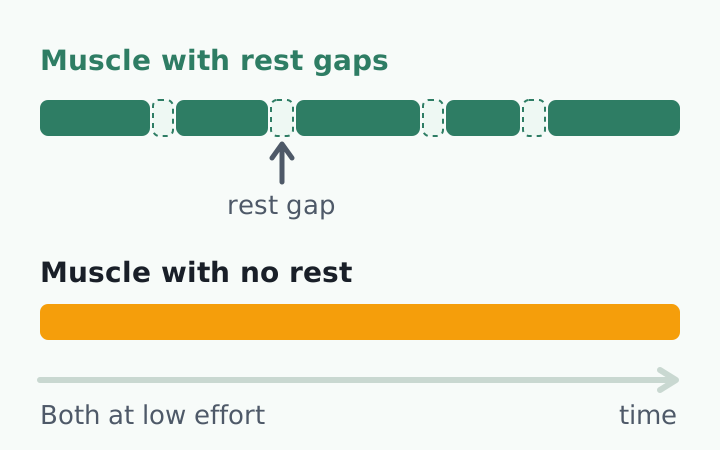
There are multiple possible mechanisms, but none of the hypotheses forms a complete explanation and is sufficiently supported by empirical data.
B. Visser and J. H. van Dieën, Vrije Universiteit Amsterdam, Journal of Electromyography and Kinesiology, 2006
"Low effort for a long time with no rest" is the best-supported candidate, not a settled fact.9 The Norwegian group also found people with pain whose trapezius activity was low, and concluded that more than one pain mechanism is probably at work.8
Desk height, keyboard height, and armrests: what lifts your shoulders
Desk setup can turn a small effort into a slightly bigger, longer one. OSHA warns that when a keyboard is too high, you may raise your shoulders to elevate your arms.10 In a study at the Swiss Federal Institute of Technology in Zurich, 16 computer users with neck and shoulder symptoms tapped keys at a properly adjusted desk and at one set 5 cm (about 2 inches) higher. The higher desk increased trapezius activity, mostly by keeping motor units active longer.13
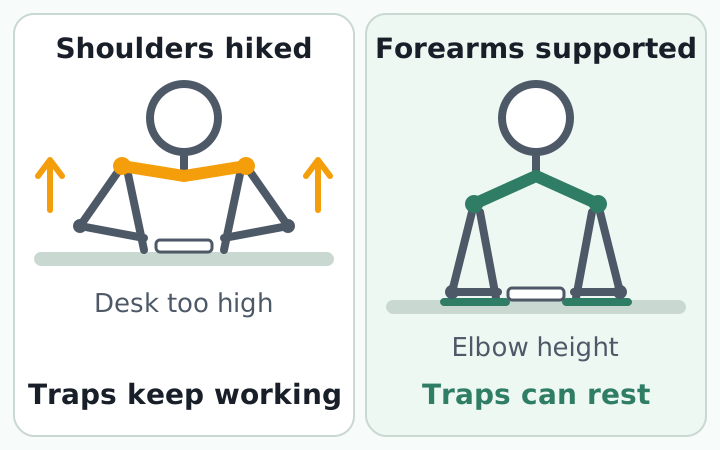
Supporting your forearms does the opposite. In a Norwegian study, typing with the forearms resting on the desk lowered trapezius load and increased the time the muscle spent below 1% of maximum.14 Height matters, though. In a study of 24 people at the University at Buffalo, forearm support at resting elbow height lowered shoulder and neck muscle activity, while support set higher raised activity above the no-support condition.15
David Rempel's team at the University of California, San Francisco randomized 182 call-center operators for one year. Those given a wide forearm support board had about half the risk of a new neck or shoulder disorder (hazard ratio 0.49).16 A Cochrane review that pooled trials like this one rated the evidence for arm supports as inconsistent.17
Slouching adds to it. When 25 healthy adults typed for 15 minutes in four positions, upper trapezius activity was highest when they slumped with no forearm support.18
| What to check | Target | Source |
|---|---|---|
| Keyboard height | About elbow height, shoulders relaxed | OSHA10 |
| Elbows | Around 90 degrees, close to your body, shoulders neither lifted nor dropped | CCOHS12 |
| Armrests | Just touching your forearms when your arms hang relaxed at your sides | OSHA11 |
| Desk that cannot go lower | Raise the chair and add a footrest | OSHA11 |
For desk and chair heights matched to your body height, see how to set monitor, desk, and chair height.
Does stress really raise your shoulders?
Cleveland Clinic says stress can make you tense muscles without knowing it, and that the shoulders, upper back, and neck are where people tend to carry it.1 In a Stockholm University experiment with 62 women, mental arithmetic and a color-word test each raised trapezius EMG.19 A 2013 meta-analysis found a medium increase in neck and shoulder muscle activity under simulated workplace stressors.20
Real offices look different. In the 26-worker study, trapezius activity during hours rated as high stress was no different from low-stress hours.3 The meta-analysis authors also pointed out that their conclusion rests entirely on laboratory studies.20 Stress probably plays a part, but how much it matters at an actual desk is not known.
Massage, stretching, or strengthening: what trials found
Feeling looser after a massage and then tight again a few days later fits the research. Here are the main trials side by side.
| Approach | Trial | Result |
|---|---|---|
| Massage | Cochrane 2024: 33 trials, 1,994 people21 | Little to no difference in pain vs. placebo up to 12 weeks (low-certainty evidence) |
| Stretching | 96 office workers, twice a day for 4 weeks22 | Pain fell 1.4 points more than in controls on a 10-point scale |
| Strength training | 48 women with trapezius pain, 10 weeks23 | Pain fell by about 79% with training aimed at the painful muscle |
| Short strength sessions | 198 workers, 2 minutes a day for 10 weeks24 | Pain fell 1.4 points more than in controls on a 10-point scale |
Many of the massage trials tested a single session, so the reviewers called the benefit uncertain.21 If you are shopping for a massage gun or a neck and shoulder massager, keep that in mind: feeling looser and staying looser are different outcomes. Buying criteria are covered in neck and shoulder massagers and massage guns.
The strength result surprises many people. Lars L. Andersen's group at Denmark's National Research Centre for the Working Environment did not rest the sore muscle. They trained it directly, and pain dropped far more than in a group that only cycled with relaxed shoulders.23 If you already have pain, ask a doctor or physical therapist how hard to start.
Do microbreaks help? Evidence and guidelines compared
Breaks are the simplest way to add rest. Here is what trials and guidelines say.
| Source | What it says |
|---|---|
| McLean et al. 200125 | Short breaks every 20 minutes reduced discomfort with no loss of productivity |
| Cochrane 202526 | 9 trials, 626 workers: the effect of extra breaks is very uncertain |
| CCOHS12 | Do not sit for more than 50 minutes at a time |
| Yale Medicine (Peter G. Whang, MD)27 | Take a break every 20 minutes. You do not have to stand; just avoid holding one position too long |
The trials are small, so no one can promise that breaks will keep pain away. They cost little, though, and they fit what the EMG studies point to: the muscle needs moments when activity drops to zero. Ways to pick an interval are in how to time desk breaks.
Here are three checks you can do at your desk today. They are a way to look at your habits, not a diagnosis.
- Stop typing, shrug your shoulders toward your ears, then let them drop. If they end up lower than where they started, you were holding them up
- With your shoulders down, compare elbow height with keyboard height. If the keyboard is higher, raise your chair and use a footrest
- Rest your forearms on the armrests or desk and see whether your shoulders get pushed up
See a doctor if trapezius pain lasts more than a week, or if it comes with numbness, tingling, or weakness in your arm or hand, or with headaches and dizziness that do not settle.1
One line to add to your routine: once an hour, lift your shoulders toward your ears and let them drop. Use it as a cue to give shoulders that have been holding on a short rest.
Before you rub them again, notice when your shoulders creep up
The best-supported reason your traps keep tightening is not heavy work. It is light work that never pauses. A high keyboard or hovering arms stretch that time out, and forearm support at elbow height gives the muscle room to rest.
The hard part is that knowing this does not help once you are absorbed in work. You do not feel the moment your head drifts toward the screen and your shoulders tense. So the practical job at a desk is building a habit: catch the moment your head moves forward and your shoulders rise, then reset.
RightPose AI is a desktop app for Windows and Mac built to help with that noticing. It uses your laptop or monitor webcam to check your posture briefly at an interval you set (5 minutes by default) and shows an on-screen alert when it sees forward head posture. The app can also show your own image with joint lines, so you can reset your head and let your shoulders drop while you are at it. It also sends reminders to stretch and stand up, which is one way to build rest gaps into your day.
If you want to start working with relaxed shoulders from today, register your good posture before you begin.
RightPose AI is not a medical device. It is a habit tool that notices your posture and nudges you to reset and stretch.
FAQ
Why is only one of my traps tight?
The side you use more does more work. In the workday study of 26 computer workers, trapezius activity on the dominant side (1.8%) was twice that of the other side (0.9%).3 Supporting the forearm during mouse use lowered the static load on the trapezius in a lab study.14 Armrests that are too low can also make you lean to one side11, so start by checking whether your mouse arm is supported.
Are the knots in my shoulders the same thing as tight traps?
Not exactly. Cleveland Clinic describes knots as trigger points: small, tender spots in a tight band of muscle that hurt when pressed and can send pain elsewhere. It lists repetitive motions and poor posture among the common causes, names emotional stress as a risk factor, and says there is no test for them; a clinician finds them by examining the muscle.2
Will a standing desk loosen my traps?
There is no good evidence that it will. In workday recordings, trapezius activity was higher while standing than while sitting.3 In a Cochrane review, the one sit-stand desk trial found no effect on upper limb pain or discomfort.17 Whether your forearms are supported seems to matter more than whether you sit or stand.14
Can tight traps cause headaches?
They can come together. Cleveland Clinic lists headaches among the symptoms of trapezius problems.1 If your headaches are frequent, read neck tension and headaches, and see a doctor if they are new, severe, or getting worse.
How do I tell trapezius pain from a pinched nerve?
You cannot be sure from symptoms alone. Yale Medicine advises contacting a doctor if pain radiates down your arm, to rule out a compressed nerve in the neck, which can also cause numbness or tingling.27 Stiffness that stays in the neck and the top of the shoulder is more typical of muscle pain.
References
- Trapezius Muscle
- Myofascial Pain Syndrome
- The influence of body posture, arm movement, and work stress on trapezius activity during computer work
- Recruitment of low threshold motor-units in the trapezius muscle in different static arm positions
- Continuous, intermitted and sporadic motor unit activity in the trapezius muscle during prolonged computer work
- Motor unit substitution in long-duration contractions of the human trapezius muscle
- Electromyographic evaluation of muscular work pattern as a predictor of trapezius myalgia
- Low-amplitude trapezius activity in work and leisure and the relation to shoulder and neck pain
- Pathophysiology of upper extremity muscle disorders
- Computer Workstations eTool: Workstation Components - Keyboards
- Computer Workstations eTool: Workstation Components - Chairs
- Working in a Sitting Position - Good Body Position
- Trapezius muscle motor unit activity in symptomatic participants during finger tapping using properly and improperly adjusted desks
- Postural load during VDU work: a comparison between various work postures
- Shoulder and neck muscle activities during typing with articulating forearm support at different heights
- A randomised controlled trial evaluating the effects of two workstation interventions on upper body pain and incident musculoskeletal disorders among computer operators
- Ergonomic interventions for preventing work-related musculoskeletal disorders of the upper limb and neck among office workers
- Prolonged slumped sitting causes neck pain and increased axioscapular muscle activity during a computer task in healthy participants - A randomized crossover study
- Psychophysiological stress and EMG activity of the trapezius muscle
- The effects of workplace stressors on muscle activity in the neck-shoulder and forearm muscles during computer work: a systematic review and meta-analysis
- Massage for neck pain
- The effectiveness of a neck and shoulder stretching exercise program among office workers with neck pain: a randomized controlled trial
- Effect of two contrasting types of physical exercise on chronic neck muscle pain
- Effectiveness of small daily amounts of progressive resistance training for frequent neck/shoulder pain: randomised controlled trial
- Computer terminal work and the benefit of microbreaks
- Work-break interventions for preventing musculoskeletal symptoms and disorders in healthy workers
- What Is Tech Neck, and How Can You Prevent It?
This article is for general information only and is not a substitute for medical diagnosis or treatment. If pain persists or worsens, consult a medical professional.