
A stiff, aching neck plus a headache usually gets one of two labels: tension-type headache, the most common headache there is, or cervicogenic headache, a headache caused by a problem in the neck. The catch is that neck pain cannot tell you which one you have. It is common with migraine too.16
This guide compares the two using the International Classification of Headache Disorders (ICHD-3), weighs the posture evidence, and lists the headache symptoms that need care right away. Only an exam can give you a diagnosis.
Why neck pain and headaches travel together
Pain signals from the upper neck (the C1 to C3 region) and from the face and head feed into the same relay in the nervous system, the trigeminocervical nucleus.15 That shared wiring is why pain from upper neck joints and muscles can be felt at the back of the head, in the forehead, or behind the eye.58
It also runs the other way: people with headaches have a lot of neck pain. Researchers from the Danish Headache Center and Mount Sinai in New York interviewed 797 adults from the general population. Overall, 68.4% had neck pain in the past year, and the rate was higher with every headache type.6
| Headache type | Neck pain in the past year |
|---|---|
| No primary headache | 56.7% |
| Migraine only | 76.2% |
| Tension-type only | 88.4% |
| Migraine plus tension-type | 89.3% |
So neck pain is the rule in migraine too, not proof that a headache starts in the neck. As a one-time survey, it cannot say whether neck pain drives the headache or is part of it.6
Cervicogenic headache vs tension headache: what the criteria say
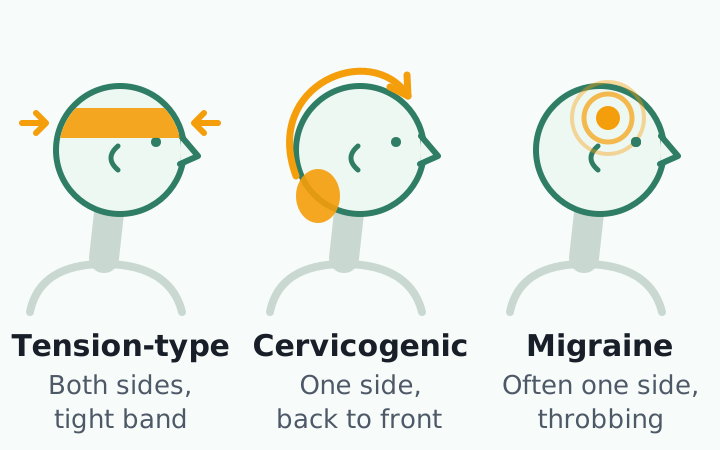
In ICHD-3, tension-type headache is a primary headache: the headache is the condition, with no other disease behind it.2 Cervicogenic headache is a secondary headache, caused by a disorder of the cervical spine or the soft tissues of the neck.1
| Feature | Tension-type headache | Cervicogenic headache |
|---|---|---|
| Type | Primary (no underlying disease)2 | Secondary (a neck disorder is the cause)1 |
| Location | Usually both sides3 | Tends to stay on one side and spread from back to front1 |
| Feel | Pressing or tightening, not pulsating3 | Your usual headache is set off by neck movement or pressure on neck muscles1 |
| How common | Lifetime prevalence of 30% to 78%2 | 3.9% in the one population study that used ICHD criteria7 |
The tension-type checklist
A tension-type headache has at least two of four features: it is on both sides, it feels pressing or tightening, it is mild to moderate, and it does not get worse with routine activity such as walking or climbing stairs. There is no nausea or vomiting, and no more than one of light sensitivity or sound sensitivity.3 Those extra symptoms point toward migraine, which the World Health Organization describes as pulsating, often one-sided, and worse with routine activity.11
Frequency sets the subtype: 1 to 14 headache days a month is frequent episodic, and 15 or more days a month for more than 3 months is chronic.34 The infrequent kind, less than once a month, happens to almost everyone and usually needs no medical attention.2 Tension-type headache and migraine often coexist, so the classification recommends a headache diary to tell them apart.3
The cervicogenic checklist
Cervicogenic headache is not diagnosed by how the pain feels. There has to be clinical or imaging evidence of a neck disorder known to cause headache, plus at least two of these four signs that it is the cause.1
- The headache started around the time the neck disorder began
- The headache improved or went away as the neck disorder improved
- Neck range of motion is reduced, and provocative maneuvers make the headache significantly worse
- The headache disappears after a diagnostic block of a neck structure or its nerve supply
The fine print matters. Imaging findings in the upper cervical spine are common in people without headache, so they suggest a cause but do not prove one. One-sided pain and headache set off by pressing on the neck are typical of cervicogenic headache but not unique to it.1
Tension-type headache is not always two-sided either. In a 2025 population study from Yonsei University in South Korea, 51.4% of 954 people with tension-type headache reported one-sided pain.20
How common is cervicogenic headache? Rarer than you may think
Health sites often treat cervicogenic headache as the default explanation for any headache with a sore neck. The numbers say otherwise. A 2025 meta-analysis from Harvard Medical School and the Danish Headache Center searched studies from 1942 through 2024 for those that diagnosed it by ICHD criteria. Only three qualified.7
The single population study found a prevalence of 3.9%. In the two clinic studies, 3.1% of 3,165 adults seen for headache had it. The authors call it a rare disorder and stress that the data are limited, so even 3.9% is a soft number.7
The term cervicogenic headache is commonly misused and does not simply apply to a headache associated with neck pain; many headache disorders, including migraine and tension-type headache, can have associated neck pain/tension.
American Migraine Foundation, Cervicogenic Headache, 2016
Diagnosis is hard even for specialists. In a 2009 Lancet Neurology review, Nikolai Bogduk of Australia's Newcastle Bone and Joint Institute concluded that clinical diagnostic criteria have not proved valid, and that a neck source of pain can be established with controlled diagnostic nerve blocks.8
Does tech neck cause headaches? What posture studies show
Forward head posture, the chin-forward position often called tech neck, does show up more in people with headaches. Research has not shown that it causes them.
| Study | Who | Finding |
|---|---|---|
| Fernández-de-las-Peñas et al., 200612 | 25 with chronic tension-type headache, 25 healthy | Craniovertebral angle 45.3° vs 54.1°: head farther forward in the headache group |
| Elizagaray-Garcia et al., 202013 | 12 studies, 1,083 people | More forward head posture in chronic primary headache |
| Farmer et al., 201514 | 30 with cervicogenic headache, 30 controls | No significant difference in neck posture on X-ray |
César Fernández-de-las-Peñas and colleagues at Universidad Rey Juan Carlos in Spain measured the craniovertebral angle, which shrinks as the head moves forward, from side-view photos of seated people. Among those with chronic tension-type headache, a smaller angle went with more frequent headaches.12
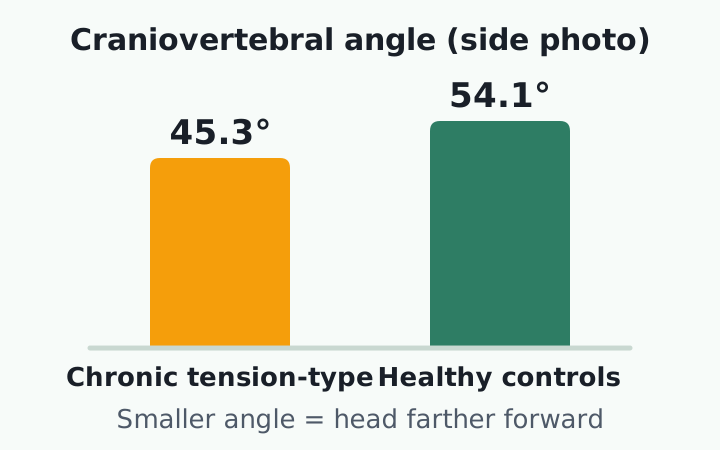
A 2020 meta-analysis of 12 studies pointed the same way, mainly for chronic headaches.13 The limit is plain: these studies compare two groups at a single moment, so they cannot tell whether posture led to the headaches or years of headaches changed how people hold their heads. The Spanish team itself called for more research.12
For cervicogenic headache the case is weaker still. Researchers at the University of Newcastle in Australia found no significant differences in neck posture on X-ray between 30 patients and 30 matched controls. Their data, they wrote, do not support posture as a cause.14
What you can try at your desk: a 1,913-worker trial
Cause or not, one large randomized trial found fewer headache days in workers who practiced easing neck and shoulder tension. Franco Mongini's group at the University of Turin randomized city employees by department and compared the groups after 6 months.16
| Item | Detail |
|---|---|
| Participants | 923 in the program, 990 controls |
| Neck and shoulder exercises | Every 2 to 3 hours, 8 to 10 repetitions each |
| Reminder | Red stickers placed where workers would see them |
| Headache days at 6 months | 1.72 fewer per month than controls |
| Neck or shoulder pain days | 2.51 fewer per month than controls |
The red stickers are the interesting part. Workers placed them where they would see them often, as a cue to check whether their head and neck muscles were clenched. One aim of the program was to make people aware of muscle tension when it rose too high.16
There are caveats. Pain days came from self-kept diaries and nobody was blinded. The program also included a daily relaxation session, so the trial cannot say which part did the work. The authors asked for trials in patients with specific headache types.16
- Keep a headache diary: days it hurt, where, how long, and days you took pain medicine10
- Set up your screen so you do not push your chin forward to read it
- Move your neck and shoulders every 2 to 3 hours, as in the Turin trial16
For the setup, see how to set monitor, desk, and chair height. For the movements, see our neck stretch routine.
Headache red flags: when to get help right away
Most headaches are not dangerous. Only a minority of headache patients have a secondary headache disorder, notes the Neurology review behind the SNNOOP10 red-flag list.18 But some are emergencies. MedlinePlus, from the U.S. National Library of Medicine, says to call 911 or your local emergency number in these cases.10
- It is the worst headache of your life
- The headache starts very suddenly
- You have speech, vision, or movement problems or loss of balance, especially if these are new for you
- The headache comes with repeated vomiting
- You have a high fever or a stiff neck with the headache
If any of these apply, do not put the headache down to posture. Get emergency care right away. Also see a clinician soon if your headache pattern changes, a first headache starts after age 65, headaches keep getting worse, or you have ongoing weakness, numbness, or dizziness.1018
How often you take pain medicine is a signal too. MedlinePlus warns that taking pain medicines more than 3 days a week may lead to rebound headaches.10 ICHD-3 defines medication-overuse headache as headache on 15 or more days a month in someone with an existing headache disorder, after more than 3 months of regular overuse.19 Talk with your doctor or pharmacist before changing anything yourself. If neck pain is your main problem, see when to see a doctor for neck pain.
The diagnosis is your clinician's job. Noticing is yours
A headache with a stiff neck can be tension-type headache, cervicogenic headache, or migraine. Location will not settle it, and cervicogenic headache is an uncommon diagnosis that requires evidence of a neck disorder. Posture and headache go together, but nobody has shown which comes first. Finding the cause belongs in the exam room.
What belongs at your desk is simpler: keep a record, and cut down the hours your neck and shoulders spend locked in one position. The hard part is that you forget once you are absorbed in work, which is why the Turin researchers used red stickers. The habit worth building is noticing the moment your head drifts toward the screen and bringing it back.
RightPose AI is a desktop app for Windows and Mac built around that noticing. You register your own upright posture first. Then, using your webcam, it checks your posture briefly at a set interval (5 minutes by default) and tells you on screen when it sees your head forward of that baseline. It also sends reminders to stretch and stand up, a cue to break up long stretches in one position.
If you have none of the warning signs, you can start a better-posture routine today, beginning with registering your good posture.
RightPose AI is not a medical device. It is a habit tool that notices your posture and nudges you to reset and stretch.
FAQ
Can a herniated disc in the neck cause headaches?
It can, though the evidence is small. In a German study of 50 people about to have surgery for a cervical disc prolapse, 12 reported new headache and neck pain, and 7 of them met the criteria for cervicogenic headache. Three months after surgery, 7 of the 12 were pain free and 3 had improved.21 That does not mean most people with a disc problem get headaches. Arm pain, numbness, or weakness are reasons to be examined.
Do I need an MRI or X-ray for a headache with neck pain?
Not automatically. ICHD-3 notes that imaging findings in the upper cervical spine are common in people who have no headache, so a finding on a scan suggests a cause but does not prove it.1 Cleveland Clinic says the most common tests are X-ray, CT, or MRI, used mainly to rule out other conditions, and that a hands-on exam of neck movement matters as well.9 Your clinician decides based on your symptoms.
How is cervicogenic headache treated?
It depends on what is found in the neck, and your clinician makes that call. The American Migraine Foundation lists nerve blocks, medications, physical therapy, and exercise as options.5 In a trial led by Gwendolen Jull at the University of Queensland, 200 people were assigned to manipulative therapy, low-load exercise, both, or no treatment for 6 weeks. At 12 months, both the manipulative therapy and the exercise groups had fewer and less intense headaches.17 That is one trial, so it cannot tell you which option fits your case.
What kind of doctor should I see for headaches with neck pain?
Start with your regular doctor. The American Migraine Foundation says people with suspected cervicogenic headache should be carefully assessed by their doctor to exclude other primary and secondary causes. Depending on the findings, care may then involve physical therapists, pain specialists who perform nerve blocks, and sometimes neurosurgeons or orthopedic surgeons.5
Does massage help a tension headache?
It may. MedlinePlus lists massage among the conservative options for tension headaches, along with relaxation or stress-management training, biofeedback, and ice or hot packs, and notes that massaging sore muscles may help.10 If a headache is sudden, severe, or comes with any red flag above, skip the self-care and get medical help.
References
- 11.2.1 Cervicogenic headache (ICHD-3)
- 2. Tension-type headache (TTH) (ICHD-3)
- 2.2 Frequent episodic tension-type headache (ICHD-3)
- 2.3 Chronic tension-type headache (ICHD-3)
- Cervicogenic Headache
- Prevalence of neck pain in migraine and tension-type headache: a population study
- Prevalence and relative frequency of cervicogenic headache in population- and clinic-based studies: A systematic review and meta-analysis
- Cervicogenic headache: an assessment of the evidence on clinical diagnosis, invasive tests, and treatment
- Cervicogenic Headache
- Tension headache
- Headache disorders
- Forward head posture and neck mobility in chronic tension-type headache: a blinded, controlled study
- Chronic Primary Headache Subjects Have Greater Forward Head Posture than Asymptomatic and Episodic Primary Headache Sufferers: Systematic Review and Meta-analysis
- An investigation of cervical spinal posture in cervicogenic headache
- Is There Support for the Paradigm 'Spinal Posture as a Trigger for Episodic Headache'? A Comprehensive Review
- An Educational and Physical Program to Reduce Headache, Neck/Shoulder Pain in a Working Community: A Cluster-Randomized Controlled Trial
- A randomized controlled trial of exercise and manipulative therapy for cervicogenic headache
- Red and orange flags for secondary headaches in clinical practice: SNNOOP10 list
- 8.2 Medication-overuse headache (MOH) (ICHD-3)
- Natural subgroups of tension-type headache: A population-based study
- Lower cervical disc prolapse may cause cervicogenic headache: prospective study in patients undergoing surgery
This article is for general information only and is not a substitute for medical diagnosis or treatment. If pain persists or worsens, consult a medical professional.