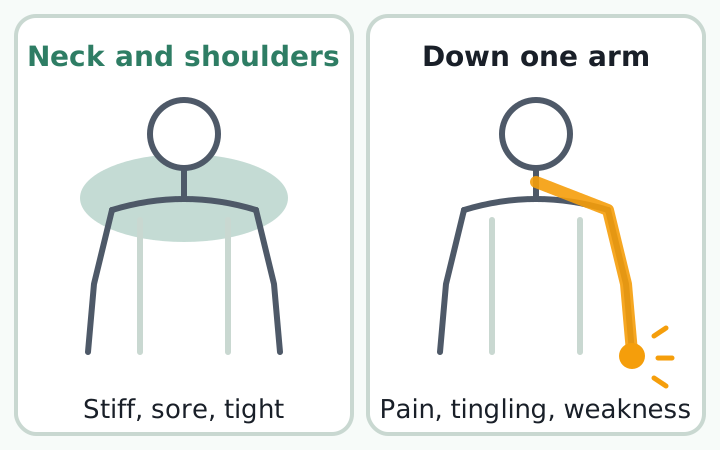
Tech neck is a posture pattern: your head drifts forward of your shoulders, and the muscles of your neck and upper back get sore from holding it there.2 A herniated cervical disc is a medical diagnosis: disc material presses on a nerve root or the spinal cord in your neck.1 The practical dividing line is where the symptoms go. Soreness that stays in your neck and shoulders fits tech neck. Pain, tingling, or weakness that travels down one arm points to a nerve and needs an exam.
You can't confirm either one from a checklist, and this article won't ask you to. It covers what each term means, what a pinched nerve in the neck feels like, what studies say about posture and discs, and when to stop adjusting your desk and call a doctor.
Tech neck is a posture, a herniated disc is a diagnosis
Cleveland Clinic describes tech neck (also called text neck) as the physical stress of tilting your head forward to look at a phone or tablet. Stiffness, soreness, or sharp pain in the neck and shoulders are the usual signs.2 Researchers call the posture itself forward head posture. You can see it in a side-view photo, and our self-check guide shows how.
A herniated disc is different in kind. The discs between your neck vertebrae have a soft center and a tough outer ring. When the center pushes through the ring toward the spinal canal, it can press on a nerve root. The American Academy of Orthopaedic Surgeons (AAOS) calls the resulting condition cervical radiculopathy, or a pinched nerve.1
| Question | Tech neck | Herniated cervical disc |
|---|---|---|
| What is it? | A head-forward posture and the muscle strain that comes with it | Disc material pressing on a nerve root or the spinal cord |
| How is it confirmed? | Side-view posture | Physical and neurological exam, MRI when needed |
| Typical symptoms | Stiffness and soreness in the neck, shoulders, and upper back | Pain, tingling, numbness, or weakness down one arm |
| Can you check it yourself? | Roughly (not a diagnosis) | No |
One more wrinkle: not every pinched nerve in the neck comes from a herniated disc. Mayo Clinic researchers reviewed the records of 561 residents of Rochester, Minnesota, diagnosed with cervical radiculopathy between 1976 and 1990. A confirmed disc protrusion was responsible in 21.9% of them. Another 68.4% were tied to spondylosis (age-related wear of the bones), a disc, or both.3
Symptoms of a pinched nerve in the neck (cervical radiculopathy)
AAOS says the pain usually starts at the neck and travels down the arm in the area served by the affected nerve. People describe it as burning or sharp. Tingling (pins and needles) in the fingers or hand, numbness, and weakness in the arm, shoulder, or hand can come with it.1 It typically affects one side of the body, not both.4
Two details help doctors. Extending your neck or turning your head often makes the arm pain worse. Resting the hand of the painful arm on top of your head sometimes eases it, because that position can take pressure off the nerve root.1
Which nerve root is involved shapes the pattern. In the Rochester study, C7 was the most common, followed by C6.3 Doctors use a map like the one below during the exam. It is condensed from a review in American Family Physician.5
| Nerve root | Where pain travels | What may get weak |
|---|---|---|
| C5 | Shoulder and outer upper arm | Lifting the arm, bending the elbow |
| C6 | Outer arm to the thumb | Bending the elbow, extending the wrist |
| C7 | Back of the forearm to the middle finger | Straightening the elbow, flexing the wrist |
| C8 | Inner forearm to the ring and little fingers | Bending the fingers (grip) |
It is not a self-test. The same review notes that pain can show up outside these borders, and only about 15% of patients report weakness.5 Use it to describe your symptoms to a doctor, not to guess which nerve is involved.
Why you can't sort it out from symptoms alone
The two overlap in both directions. A pinched nerve can cause pain around the back of the shoulder and the shoulder blade, which the review calls relatively nonspecific.5 And health systems that write about tech neck list arm symptoms too. Cleveland Clinic includes numbness and tingling in the arm, hand, and fingers from nerve irritation. Brian Langenhorst, an ergonomics specialist at Mayo Clinic Health System, describes referred pain in the arms and hands.26
Arm and hand symptoms also have causes outside the neck. AAOS lists conditions that mimic cervical radiculopathy, including shoulder problems, nerve compression at the elbow (cubital tunnel syndrome) or wrist (carpal tunnel syndrome), and heart disease.1
| What to notice | More typical of muscle strain | See a doctor first |
|---|---|---|
| Where it is | Neck, shoulders, between the shoulder blades | One arm, down to specific fingers |
| What it feels like | Stiff, tight, achy | Burning, sharp, tingling, numb |
| Strength | Unchanged | Dropping things, trouble lifting the arm |
| Hands and walking | Unchanged | Clumsy with buttons or handwriting, unsteady on your feet |
This table sorts urgency, not diagnoses.114 If anything in the right-hand column sounds familiar, an exam comes before posture work.
Can tech neck cause a herniated disc?
You will see this stated as fact. Mayo Clinic's news site says extra spinal pressure from tech neck can lead to herniated discs, and Cleveland Clinic chiropractor Andrew Bang, DC, says clinicians see cervical discs degenerating because of forward head posture.62 Those are clinical observations. Studies that measure people directly are more cautious.
| Study | Who and how | What it found |
|---|---|---|
| Okada et al., 20097 | 113 symptom-free volunteers in Japan, repeat MRI after 11.3 years on average | Disc protrusion progressed more often in people over 40 whose neck had lost its curve. Alignment did not predict who developed symptoms |
| Kelsey et al., 19848 | U.S. patients with an acute prolapsed cervical disc, compared with controls | Linked to heavy lifting at work, cigarette smoking, and diving. Time spent sitting on the job did not appear to affect risk |
| Zhuang et al., 20219 | 2,438 young patients with chronic neck pain in China, MRI plus a smartphone-use survey | Heavier smartphone users had higher disc degeneration scores |
| Correia et al., 202110 | 582 adults in Brazil, neck flexion measured while texting | Flexion angle was not associated with how common, frequent, or intense neck pain was |
Each has limits. Okada's team measured the curve of the neck on X-ray, which is not the same thing as head position. Zhuang's study looked at people who were already in pain, at one point in time, so it cannot show which came first. Kelsey's data predate smartphones. Correia's study measured neck pain, not discs.
A fair reading: there is reason to think that hours of sustained neck flexion add load to your discs, but no study here shows that tech neck by itself turns into a symptomatic herniated disc. The cause AAOS names first is age-related wear.1
A disc on your MRI is not the same as a disc problem
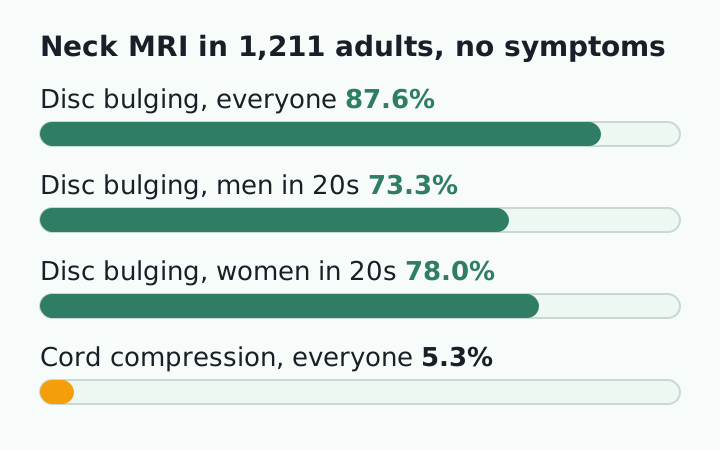
Researchers in Japan scanned the necks of 1,211 healthy volunteers aged 20 to 70. Disc bulging showed up in 87.6% of them, including 73.3% of men and 78.0% of women in their 20s. Spinal cord compression was far less common, at 5.3%.11 An earlier U.S. study of 63 symptom-free volunteers found a herniated disc in 10% of those under 40.12
Something that looks menacing to the untrained eye may instead be as normal as the wrinkles on the aging skin.
Alexander C. Simotas, MD, attending physiatrist, Hospital for Special Surgery, HSS Health Library, 2025
This is why doctors match imaging to your symptoms and exam before naming a cause.13 AAOS puts it plainly: nearly half of all people middle-aged and older have worn discs and pinched nerves that do not cause painful symptoms, and it is not known why some people develop symptoms and others do not.1
When to see a doctor, and what to hold off on
Our guide on when to see a doctor for neck pain covers the full list of warning signs. For this topic, these are the ones that matter.
See a doctor if pain, tingling, or numbness travels down your arm and has not eased after a week, and sooner if your arm or hand is getting weak.4 Trouble with buttons or handwriting, loss of balance, or difficulty walking can mean the spinal cord is being squeezed and needs prompt evaluation.14 Sudden loss of bladder or bowel control is an emergency.
Until you have been examined, hold off on two things people often try first.
- Neck manipulation. AAOS states that chiropractic-style manipulation should never be used for spinal cord compression.14 An exam should rule that out before anyone adjusts your neck.
- A do-it-yourself exercise program. A Cochrane review found only low-quality evidence of a small pain benefit from stretching and strengthening exercises in acute radiculopathy.15 HSS advises doing nerve-related neck exercises only as instructed by a healthcare provider.13
If your symptoms are limited to a stiff, tired neck after long screen sessions, the basics apply: raise the screen toward eye level, change position often, and take breaks. As Dr. Bang puts it, "The best posture is a moving posture."2 Our desk setup guide has the measurements.
Leave the diagnosis to the exam room, keep the habit at your desk
Tech neck names a posture. A herniated disc is a diagnosis that depends on symptoms, an exam, and imaging lining up. Symptoms that travel down an arm belong in a doctor's office, and a disc that shows up on a scan is not automatically the cause of your pain.
What remains is the time you spend at a screen. Whether or not you have seen a doctor, how long you hold your head forward is something you can change. The hard part is that once you are absorbed in work, you rarely notice the moment your head drifts toward the screen. So the useful thing to build at your desk is a habit: notice when your head has moved forward, and bring it back.
RightPose AI is a desktop app for Windows and Mac that handles the noticing. You register your own upright posture first. Then it uses your webcam to take a brief look at a set interval (5 minutes by default) and shows an on-screen alert when you are in a forward head posture. It also reminds you to stand up and stretch at regular intervals. It has no way of sensing numbness or weakness, so take those to a clinician.
If you have none of the warning signs, you can start a better-posture routine today, beginning with registering your good posture.
RightPose AI is not a medical device. It is a habit tool that notices your posture and nudges you to reset and stretch.
FAQ
How long does a pinched nerve in the neck take to get better?
Most people improve with time. A systematic review of cervical disc herniation with radiculopathy found that substantial improvement tends to occur within the first 4 to 6 months, and about 83% of patients recovered completely within 24 to 36 months.16 In the Rochester study, 31.7% had a recurrence and 26% went on to have surgery, so follow-up with your doctor matters.3
Is numbness in my fingers always coming from my neck?
No. Carpal tunnel syndrome causes numbness from the thumb through half of the ring finger, and cubital tunnel syndrome affects the ring and little fingers. Each can mimic a nerve root problem in the neck: carpal tunnel resembles C6 or C7, and cubital tunnel resembles C8 or T1.5 Nerve tests such as EMG can help tell them apart.1
How do doctors test for a pinched nerve in the neck?
Besides checking strength, sensation, and reflexes, many use the Spurling test: the examiner tilts and extends your neck, then presses down gently to see whether it reproduces the arm symptoms.5 A 2018 systematic review found the test highly specific (0.89 to 1.00) but variable in sensitivity (0.38 to 0.97), so a negative result does not rule a pinched nerve out.17 Don't try it on yourself.
Do I need an MRI for neck pain?
Usually not at first. The American Family Physician review says imaging is not required unless there is a history of trauma, persistent symptoms, or red flags, and it recommends MRI when there is no improvement after four to six weeks or when nerve findings get worse.5 Because disc changes are so common in people without symptoms, a scan ordered too early can raise more questions than it answers.11
References
- Cervical Radiculopathy (Pinched Nerve)
- Tech Neck: A Modern-Day Pain
- Epidemiology of cervical radiculopathy. A population-based study from Rochester, Minnesota, 1976 through 1990
- Cervical Radiculopathy (Pinched Nerve)
- Nonoperative Management of Cervical Radiculopathy
- Tech neck is a pain in more than just the neck
- Does the sagittal alignment of the cervical spine have an impact on disk degeneration? Minimum 10-year follow-up of asymptomatic volunteers
- An epidemiological study of acute prolapsed cervical intervertebral disc
- Association between excessive smartphone use and cervical disc degeneration in young patients suffering from chronic neck pain
- Association Between Text Neck and Neck Pain in Adults
- Abnormal findings on magnetic resonance images of the cervical spines in 1211 asymptomatic subjects
- Abnormal magnetic-resonance scans of the cervical spine in asymptomatic subjects. A prospective investigation
- Cervical Radiculopathy: Pinched Nerve in the Neck
- Cervical Spondylotic Myelopathy (Spinal Cord Compression)
- Exercises for mechanical neck disorders
- The course and prognostic factors of symptomatic cervical disc herniation with radiculopathy: a systematic review of the literature
- Value of physical tests in diagnosing cervical radiculopathy: a systematic review
This article is for general information only and is not a substitute for medical diagnosis or treatment. If pain persists or worsens, consult a medical professional.