
A cervical pillow can help a little with neck pain, but it will not fix text neck or restore the curve in your neck. The best evidence shows small drops in pain for some pillow types and no change in sleep quality.1 The thing that matters most is height: the pillow should keep your neck level with your spine in the positions you actually sleep in.
This guide walks through what the research found, where the popular height numbers come from, how to check your own height by sleep position, and what studies say about contour, memory foam, latex, and feather pillows.
Do cervical pillows help neck pain? What the reviews found
In 2021, a team at the Caritas Institute of Higher Education in Hong Kong pooled 35 pillow studies. Among the 9 high-quality trials (555 people with chronic neck pain), latex (rubber) and spring pillows lowered neck pain, waking pain, and disability scores. The effect on pain was small (a standardized difference of about 0.26), and pillow design made no difference to sleep quality.1
A 2025 systematic review from India was more cautious. Looking at 5 trials since 2015 (239 people), it found pain scores dipped slightly but not significantly, and no material, whether latex, foam, or standard, was clearly better. The authors concluded there is limited evidence for pillows as an add-on to other care.2
| Study | Who | Finding |
|---|---|---|
| Pang et al. 2021, meta-analysis1 | 9 trials, 555 adults with chronic neck pain | Latex and spring pillows: small pain reduction, no change in sleep quality |
| Ghosh et al. 2025, systematic review2 | 5 trials, 239 adults | Slight, non-significant pain drop; no material clearly better |
| Helewa et al. 2007, randomized trial3 | 151 adults | Pillow alone: no clear effect; pillow plus exercise: meaningful effect |
| Vanti et al. 2019, crossover trial4 | 64 adults | Spring pillow for 4 weeks: less neck pain and headache |
The Canadian trial from the University of Western Ontario's School of Physical Therapy is the most telling. People who only got a new pillow, or only did exercises, did not differ clearly from the control group. The group whose physical therapists taught both exercises and pillow use did best.3 A pillow works better as one piece of a plan than as the whole plan.
Can a pillow fix text neck or a straight neck?
Not based on current evidence. Pillow height does change your neck angle while you lie there. In a Korean X-ray study of 16 healthy adults aged 20 to 30, the C2 to C7 angle went from about 10 degrees with no pillow to about 15 degrees on a 10 cm pillow and 17 degrees on a 20 cm pillow.5 But no study we found shows that angle staying with you after you get up.
Text neck is about where your head sits over your shoulders during the day. A straight neck (loss of cervical lordosis) is a curve seen on an X-ray. If you want the difference explained, see straight neck vs. text neck. Treat any pillow sold as a posture fix with healthy doubt.
Pillow height by sleep position
You will see neat numbers online, like 4 inches for back sleepers and 6 for side sleepers. We could not find research behind them. A Hong Kong Polytechnic University team that studied pillow height put it plainly: there are no universal, evidence-based guidelines for pillow design or selection.6 Shoulder width, head size, and how far your mattress sinks all change the answer.
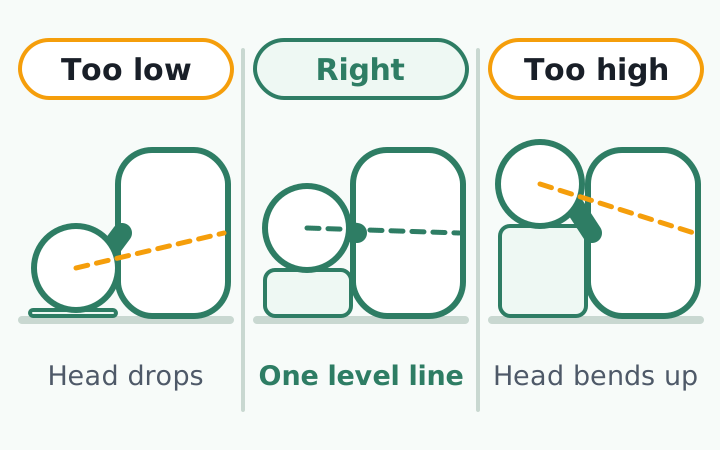
What holds up is a principle. Cleveland Clinic's rule of thumb is that a pillow should keep your neck parallel to the mattress, not bent down or up.9 For back sleepers, Harvard Health suggests a rounded support under the neck with a flatter cushion for the head, and for side sleepers, a pillow that is higher under the neck than under the head.8 Harvard also notes that a pillow that is too high or stiff keeps the neck flexed overnight, which can mean morning pain and stiffness.8
| Position | Height target | How to check |
|---|---|---|
| Back | Fill the gap behind your neck; keep the head part flatter8 | Chin is neither tucked to chest nor tipped up |
| Side | Fill the space from shoulder to head so the neck stays parallel to the bed9 | Line from nose to center of chest is level with the bed |
| Stomach | As low as possible | Your head is twisted; try a side position with a body pillow9 |
| Combination | One height that works on back and side | You don't reach to fix the pillow after rolling |
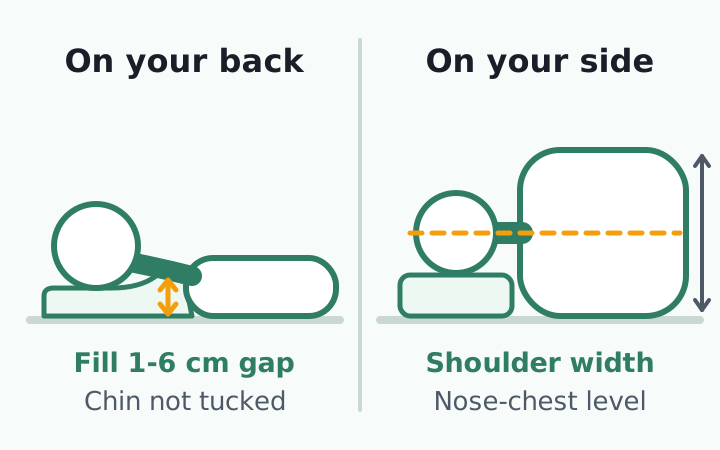
Mayo Clinic's advice for neck pain follows the same idea: keep your head and neck aligned with your body, use a small pillow to support your neck, and try pillows under your knees if you sleep on your back.10 Johns Hopkins Medicine adds a caveat: for some people with neck pain, sleeping face up makes it worse, so experiment with positions and pillows.7
Side sleepers: why shoulder width matters
Most people spend a large part of the night on their side. A Danish study put accelerometers on 664 workers and found they spent 54.1% of their time in bed on their side, 37.5% on their back, and 7.3% on their front, changing position about 1.6 times an hour.11 So a pillow tuned only for your back will spend half the night at the wrong height.
A 2025 study from Beihang University in China had 9 healthy adults lie on their side on pillows of 8, 10, 12, and 14 cm. The height that kept the neck closest to its standing curve depended on shoulder width, and the height people rated most comfortable was not the one with the best alignment.12 Comfort in the first minute is not a reliable test.
Contour, memory foam, latex, feather: what the studies compared
Most of the material research comes from physiotherapist Susan Gordon and colleagues at James Cook University in Australia. In a week-by-week field trial, 106 side sleepers tried their own pillow plus five others. Latex did best for waking neck pain, people's own pillows performed about as well as foam and polyester, a foam contour shape showed no advantage over a regular shape, and the authors said feather pillows should not be recommended.13
| Type | What studies saw | What to check |
|---|---|---|
| Latex | Fewest waking symptoms in side sleepers13 | Latex allergy |
| Memory foam | Less neck curve and more heat than an orthopedic design (20 adults, 30 min)14 | Judge the height after it compresses |
| Feather | Most waking symptoms and most dropouts15 | Replace about once a year if you use one8 |
| Contour (cervical) | Same as a regular foam shape for neck slope16 | Worth trying if you mostly sleep on your back |
Their lab study found the same thing from another angle: switching between contour and regular foam did not change neck slope, but switching to feather did.16 Cleveland Clinic chiropractor Andrew Bang notes that memory foam bending to your shape does not mean it gives the support you need.9 What counts is whether the pillow holds its height once your head is on it.
Give any pillow time. When researchers tracked 24 women lying on their side, the time for the neck to settle varied widely, and 70.8% had stabilized within 15 minutes.17 A one-minute test in a store tells you little, so if you can, lie in each position for 15 minutes or more.
If neck pain lasts for weeks after waking, or comes with numbness, tingling, or weakness in your arm or hand, or with dizziness, see a doctor before you buy another pillow. A pillow is not a diagnosis or a treatment. Warning signs are listed in when to see a doctor for neck pain, and text neck vs. a herniated disc explains how the two differ.
How to test a pillow tonight: 5 steps
Before you read another "best pillow" list, set your own baseline. This is a way to tune height, not a self-diagnosis.
- For a few mornings, note the position you wake up in and whether it matches how you fell asleep.
- Slide a folded towel under your current pillow, or take one out, and change the height about 1 cm at a time.
- Have someone check your chin on your back and your nose-to-chest line on your side, or take a photo.
- Lie on any new pillow for at least 15 minutes per position, then track how your neck feels each morning for several days.
- Choose a pillow you can adjust or return, and skip ones that promise to fix, cure, or prevent anything.
A small habit for your daily routine: spend the last 10 minutes before bed sitting up to wind down instead of scrolling on your back, and save the pillow for sleep.
Your pillow covers the night. Your desk covers the day.
A good cervical pillow keeps your neck from bending while you sleep, and there is modest evidence it can ease neck pain. There is no good evidence it reshapes your spine, and the right height is something you find for your body and positions, not a number on a box.
That leaves the daytime. A pillow handles a few hours at night, but at your desk your head drifts toward the screen when you are focused, and it is hard to notice that moment yourself. What you can do at your desk is build the habit of catching your head moving forward and bringing it back.
RightPose AI is a desktop app for Windows and Mac that takes on those daytime hours. You register your own good posture once, and it uses your laptop or monitor webcam to check briefly at a set interval (every 5 minutes by default), showing an on-screen alert when your head has moved forward into a text neck position. Camera images are processed only on your device and never leave it, and it can remind you to stand up and stretch your neck at regular times.
If you're building a better daily routine, pair the right pillow at night with a desk setup that notices you during the day, starting with registering your good posture.
RightPose AI is not a medical device. It is a habit tool that notices your posture and nudges you to reset and stretch.
FAQ
Is it normal for my neck to feel worse after switching to a cervical pillow?
There is little research on how long it takes to adjust to a new pillow. For context, in an Australian trial about 20% of people had waking stiffness or headache at least once in a week even on their own familiar pillow.15 If discomfort lasts more than a few days, retune the height with a towel, and see a doctor if pain continues.
Is it better for your neck to sleep without a pillow?
On your back there is a hollow behind your neck, and Mayo Clinic suggests a small pillow to support it.10 Without a pillow, that space stays open and your head tends to tip back. If you sleep on your stomach, the twisted head position itself is the bigger strain, and Cleveland Clinic suggests a body pillow to help you stay on your side.9
How often should you replace a pillow?
No study sets a replacement schedule for each material. Harvard Health suggests replacing feather pillows about once a year because they collapse over time.8 For any pillow, if it now compresses lower than it used to or you keep refolding it at night, recheck the height.
What pillow height is best for neck pain?
There is no single height backed by research.6 One small X-ray study of 16 healthy adults on their back found 10 cm kept the neck curve closest to normal, but the authors did not measure comfort and said the value is not absolute.5 Start from the gap behind your neck and your shoulder width, and adjust from there.
References
- The effects of pillow designs on neck pain, waking symptoms, neck disability, sleep quality and spinal alignment in adults: A systematic review and meta-analysis
- Effect of pillow on pain, disability and sleep quality in patients with chronic neck pain: A systematic review
- Effect of therapeutic exercise and sleeping neck support on patients with chronic neck pain: a randomized clinical trial
- Effectiveness of a "Spring Pillow" Versus Education in Chronic Nonspecific Neck Pain: A Randomized Controlled Trial
- The Effect of Different Pillow Heights on the Parameters of Cervicothoracic Spine Segments
- Effect of pillow height on the biomechanics of the head-neck complex: investigation of the cranio-cervical pressure and cervical spine alignment
- Choosing the Best Sleep Position
- Say "good night" to neck pain
- Is Your Pillow Giving You a Stiff Neck While You Sleep?
- Neck pain: Symptoms and causes
- Sleep positions and nocturnal body movements based on free-living accelerometer recordings
- The individualized optimal pillow height and neck support design for side sleepers
- Pillow use: the behaviour of cervical pain, sleep quality and pillow comfort in side sleepers
- Improving the quality of sleep with an optimal pillow: a randomized, comparative study
- Pillow use: the behavior of cervical stiffness, headache and scapular/arm pain
- A randomized, comparative trial: does pillow type alter cervico-thoracic spinal posture when side lying?
- Time to stabilisation of the cervical spine when supported by a pillow in side lying
This article is for general information only and is not a substitute for medical diagnosis or treatment. If pain persists or worsens, consult a medical professional.