
Tech neck lines are real creases, but looking down at your phone is not what creates them. Anatomists describe horizontal neck lines as natural creases that are there from birth1, and they deepen as neck skin gets thinner and less elastic with age.3 The claim that hours of looking down makes them deeper is plausible, but so far it rests on case reports and expert opinion.79
This guide sorts what is known from what is assumed. You will see why people in their 20s get neck lines, how much research sits behind each care option, and three things you can check at your desk today.
Horizontal neck lines start as natural creases
Neck wrinkles come in two main shapes. Horizontal lines run around the neck like a necklace. Vertical bands run down the front from under the chin, and they come from the platysma, the thin sheet of muscle that covers the front of the neck.1
Horizontal lines have a different origin. A 2022 anatomy review by Korean anatomists calls them innate lines that are present from birth on the front of the neck. They are thought to be linked to retaining ligaments, the fibrous ties that anchor skin to the tissue underneath.1 That statement comes from the discussion section of a review, not from a study of newborns.
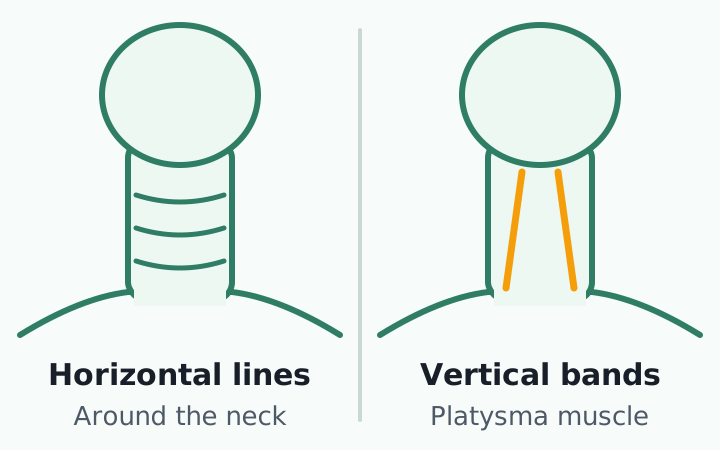
| Type | Horizontal lines | Vertical bands |
|---|---|---|
| What you see | Creases around the neck | Two cords down the front |
| Linked structure | Retaining ligaments (proposed)1 | Platysma muscle1 |
| What deepens them | Less elasticity, thinner skin, gravity, muscle pull3 | Muscle pulling into bands1 |
A popular rule says horizontal lines come from posture and vertical bands come from aging. The research does not split that neatly. In a paper that built a rating scale for these lines, UCLA dermatologist Derek Jones and colleagues wrote that horizontal neck lines can occur at any age. They added that the lines get worse as neck skin loses elasticity and thickness, combined with gravity and the downward pull of the platysma.3
Neck lines in your 20s: why age alone doesn't explain them
Seeing neck lines in your 20s is common. Fangwen Tseng and Hsiaoen Yu, physicians at aesthetic clinics in Taiwan, wrote that horizontal neck wrinkles are not entirely caused by aging, because they are often seen in children and young adults.2 They also noted that overweight patients tend to have deeper lines, since the skin rolls between the creases thicken with added fat.2
Keep in mind where those remarks come from. They sit in the introduction and discussion of a filler case series of 32 women aged 23 to 61. The authors did not measure weight, posture, or age as causes.
The age effect itself has been measured. Researchers at LMU Munich tested neck skin in 77 people with suction and imaging devices. Overall elasticity fell from 75.1% in the young group to 64.5% in the middle-aged group and 55.8% in the older group.4 A study of 58 Korean women aged 25 to 64, run by a cosmetics company lab, found neck elasticity tracked age more closely than cheek or forearm skin did.5
| Study | Who | Finding |
|---|---|---|
| Engerer et al. 20224 | 77 adults, 3 age groups | Elasticity 75.1% → 64.5% → 55.8% |
| Kim et al. 20135 | 58 Korean women | Neck elasticity vs age: r = -0.550 |
| Tseng & Yu 20192 | 32 women, case series | Lines common in young adults (authors' view) |
| Jones et al. 20163 | 297 people, scale test | Often seen in young people without much sun damage (authors' experience) |
Neck wrinkles from looking down: how strong is the evidence?
The paper most often linked to phone-related neck lines is a 2015 report from a dermatology team at Chung-Ang University in Seoul, written with researchers from a cosmetics company. It describes two women, aged 29 and 32, treated for neck wrinkles. The authors suggested that more young patients were showing up possibly because of the head-down posture they use with computers and smartphones.6 They did not measure anyone's posture, and they gave no numbers for the rise.
How far people bend their heads has been measured. In a lab study at Ulsan National Institute of Science and Technology, 18 people held their heads 33 to 45 degrees forward from vertical (median) while using a phone. Texting bent the head more than browsing or watching video, and sitting bent it more than standing.7 That study looked at necks, not skin.
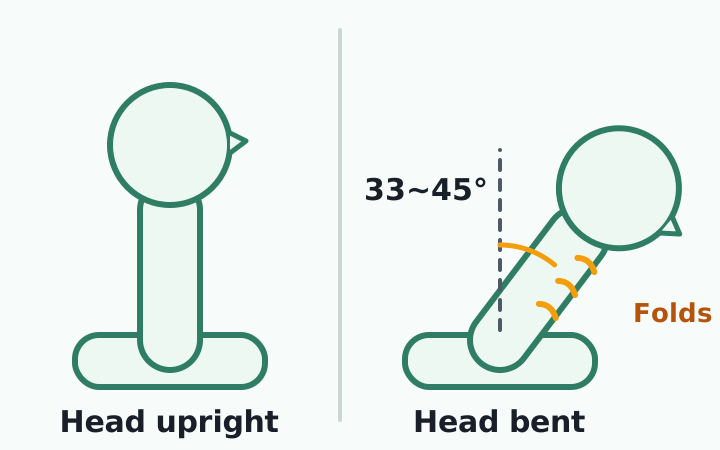
You can see the skin fold when you look down, so the theory is easy to picture: fold a spot often enough and the crease sets. The American Academy of Dermatology (AAD) says that contracting the same facial muscles for many years makes expression lines permanent.10 That is about the face, though, and no one has tested the same idea on the neck.
It makes sense, in theory.
Justine Hextall, consultant dermatologist and fellow of the Royal College of Physicians, UK, BBC Future 2026
In the same article, Hextall said that leaning forward and folding your neck all the time could be a problem, but that there have not been any good studies proving the link.8 Cleveland Clinic's health site says tech neck can lead to horizontal lines, without citing a study.9 Searching PubMed and the wider web, we found no study that measured screen time or head angle alongside neck lines. That is not proof the link is false. It means the link is untested.
| Claim | Type of evidence | Strength |
|---|---|---|
| Sun speeds up skin aging | Randomized trial11 | Strong |
| Neck elasticity drops with age | Measurement studies45 | Moderate |
| Looking down causes neck lines | 2-patient case report, expert opinion68 | Weak |
Sun and age: the causes with the best evidence
Among the causes of neck lines, sun exposure has the firmest support. The AAD says the sun plays a major role in aging skin early, and that smoking greatly speeds up how fast skin ages.10
The strongest data come from Nambour, Australia. Researchers at the Queensland Institute of Medical Research randomly assigned 903 adults under 55 to daily sunscreen or use as they pleased, then followed them for 4.5 years. The daily group showed no detectable increase in skin aging, and their skin aged 24% less than the other group's.11 The trial graded fine skin texture, not neck lines specifically.
The neck is easy to skip. The AAD tells you to apply sunscreen to all skin not covered by clothing and to remember your neck.12 Its basics look like this:
| AAD advice | Detail |
|---|---|
| Strength | SPF 30 or higher, broad spectrum, water resistant12 |
| Timing | About 15 minutes before going out12 |
| Amount | About 1 ounce (a shot glass) for exposed skin12 |
| Reapply | Every 2 hours outdoors, and after swimming or sweating12 |
How to get rid of neck lines: what each option has behind it
Plenty of methods promise to erase neck lines, and the evidence behind them varies a lot. Whether you treat your neck lines at all is your call. The table below lays out what has actually been studied.
| Option | Evidence found | Worth knowing |
|---|---|---|
| Daily sunscreen | 903-person randomized trial11 | Did not measure the neck alone |
| Moisturizer | AAD lists it with sunscreen as most effective13 | Results are modest13 |
| Neck cream | 35-woman trial, no comparison group14 | 3 of 4 authors from a skin care company |
| Hyaluronic acid filler | Review of 11 studies, 379 people15 | Half retreated within 12 months |
| Stretches, massage, pillows | No study measuring neck lines found | Effect on lines unknown |
If you are shopping for a neck cream, the AAD offers a reality check. Anti-aging products deliver modest results, you cannot get a facelift from a cream, and effective products come in all price ranges.13 One neck cream trial had 35 Chinese women apply a product twice a day for 84 days, but it had no comparison group.14
Neck fillers belong in a clinic. A 2026 meta-analysis found that hyaluronic acid fillers improved horizontal neck line scores. It also found that about half of people were retreated within 12 months, and 14% had complications, all mild and short-lived.15 The authors rated their own evidence level 4 on a scale where 1 is strongest. If you are considering any procedure, talk it through with a board-certified dermatologist.
3 things to check at your desk today
The link between looking down and neck lines is unproven. Still, hours of head-down time is one of the few factors here that you control. For what that posture does to your neck itself, see what causes text neck.
- Have someone snap a side photo while you text. Lab users bent 33 to 45 degrees.7
- Check that the top of your laptop or monitor screen sits near eye level. The steps are in setting your monitor height.
- Count how often you look up and take a break in an hour. Use the break timing guide as a starting point.
Building better habits? Add one line to your morning routine: carry your sunscreen down your neck and the back of your neck. It is the best-supported step on this list and takes a few seconds.12
If you notice a new lump in your neck, a sudden change in the skin, or neck pain with arm numbness that keeps coming back, do not treat it as a wrinkle issue. See a doctor for a proper check.
Before the lines, notice the head-down time
Horizontal neck lines are natural creases that deepen with age and sun. The idea that looking down deepens them further is a reasonable guess that nobody has tested yet. What you can change is how many hours a day you spend with your head bent.
The catch is that you forget. Once you are absorbed in work, you rarely notice the moment your head drops or drifts toward the screen. So the useful habit at your desk is catching that moment and bringing your head back.
RightPose AI is a desktop app for Windows and Mac built to help you notice. It uses your laptop or monitor webcam to check your posture briefly at a set interval (every 5 minutes by default) and shows an on-screen alert when your head moves forward. Camera images are processed on your device and never leave it, which matters when the camera is pointed at your face and neck.
If you're building a better daily routine, start by registering your own good posture today, and let the screen tell you when your head starts drifting forward.
RightPose AI is not a medical device. It is a habit tool that notices your posture and nudges you to reset and stretch.
FAQ
Are neck wrinkles a sign that something is wrong with my health?
No. Cleveland Clinic notes that neck wrinkles are not harmful to your health and are not a sign that anything is wrong with your skin.9 A new lump or a sudden skin change is a different matter, so get that checked.
Do I need a special tech neck cream?
We found no good evidence that you do. Neck skin is thinner than facial skin and has fewer hair follicles, so it can show aging sooner.9 Dermatologist Justine Hextall advises against buying special tech neck products.8 Extending your regular sunscreen and moisturizer down to your neck is a simple first step.
Does smoking affect neck lines?
It affects skin aging in general. The AAD says smoking greatly speeds up how quickly skin ages and causes wrinkles and a dull complexion.10 That advice is about skin overall, not the neck alone.
References
- Anatomical Proposal for Botulinum Neurotoxin Injection Targeting the Platysma Muscle for Treating Platysmal Band and Jawline Lifting: A Review
- Treatment of Horizontal Neck Wrinkles with Hyaluronic Acid Filler: A Retrospective Case Series
- Development and Validation of a Photonumeric Scale for Evaluation of Transverse Neck Lines
- Aging of the Neck Decoded: New Insights for Minimally Invasive Treatments
- Age-related changes in skin bio-mechanical properties: the neck skin compared with the cheek and forearm skin in Korean females
- Novel treatment of neck wrinkles with an intradermal radiofrequency device
- Head flexion angle while using a smartphone
- Weak hands and blurry vision: Is your tech giving you 'phone body'?
- Neck Wrinkles? Here's What Can Help
- 11 ways to reduce premature skin aging
- Sunscreen and prevention of skin aging: a randomized trial
- How to apply sunscreen
- How to select anti-aging skin care products
- A Rejuvenating treatment targeting "tech neck" lines and wrinkles in Chinese women: A prospective, open-label, single-center study
- Efficacy and Safety of Hyaluronic Acid Fillers for Horizontal Neck Lines: A Systematic Review and Meta-Analysis
This article is for general information only and is not a substitute for medical diagnosis or treatment. If pain persists or worsens, consult a medical professional.