
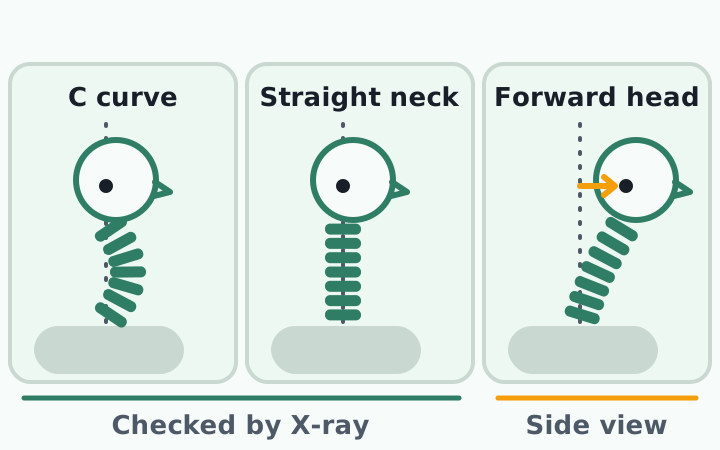
Military neck and forward head posture are not the same thing. Military neck is about the curve of your neck bones, and you need an X-ray to see it. Forward head posture, often called tech neck or text neck, is about where your head sits relative to your shoulders, and you can see it in a side photo. Many people have both, but you can have one without the other.
If your X-ray report says "straightening of the normal cervical lordosis" or "loss of cervical lordosis," this article is for you too. It covers what each term measures, where the "normal" numbers come from, and what research says about pain.
Military neck vs. forward head posture at a glance
Your neck has seven bones, the cervical vertebrae. Seen from the side, they normally form a gentle C-shaped curve that opens toward your back. Doctors call this curve lordosis. In military neck, the curve straightens or even reverses, and the medical name is cervical kyphosis. The nickname comes from the straight-necked posture it gives, similar to a soldier's.1
Forward head posture is a different measurement: how far your head sits in front of your trunk in a side view. A 2019 systematic review calls it the most common postural fault of the neck in that view, found to some degree in almost all populations.8
| Question | Military neck | Forward head posture |
|---|---|---|
| What it describes | Curve of the 7 neck bones | Head position relative to the trunk |
| How it is checked | Side-view X-ray | Side-view photo or posture exam |
| Other names | Loss of cervical lordosis, straight neck, cervical kyphosis | Tech neck, text neck |
| Visible from outside? | Often not | Yes |
| Can you check it yourself? | No | Roughly, but it is not a diagnosis |
What counts as a normal neck curve? From 12.7° to 34.5°
The curve is usually measured between the second and seventh neck bones (C2 to C7). There is no single agreed normal value. Results depend on the measuring method (Cobb or posterior tangent) and on who was counted as "normal."2
| Study | Who | Finding |
|---|---|---|
| Guo et al., 2018 meta-analysis2 | 15,364 people without symptoms | About 64% had a lordotic curve; mean 12.7° (Cobb) or 18.6° (posterior tangent) |
| Harrison et al., 20044 | 72 people without symptoms | Mean 34.5° (posterior tangent), 26.8° (Cobb) |
| McAviney et al., 20053 | 277 neck X-rays | Proposed 31° to 40° as "clinically normal" |
| Virk et al., 20205 | 84 volunteers without symptoms | 32.1% had a curve that bends the opposite way |
You will often read that a normal curve is 31° to 40°. That range comes from the McAviney study, which proposed it as a goal for chiropractic care.3 The much larger 2018 meta-analysis found lower averages in people with no symptoms, and roughly one in three did not have a lordotic curve at all.2
Researchers at the Hospital for Special Surgery in New York sorted 84 symptom-free volunteers into three neck shapes: 32.1% had a kyphotic (reversed) curve, 51.2% a medium lordosis and 16.7% a large lordosis. Their conclusion was that normal neck alignment covers a broad range.5
Does loss of cervical lordosis cause neck pain?
This is where studies disagree. Some found that people with neck pain have a flatter curve. Others, including the largest review, found no link.
| Study | Who | Curve and pain |
|---|---|---|
| McAviney et al., 20053 | 277 X-rays | Neck symptoms more likely at 20° or less |
| Harrison et al., 20044 | 72 without pain, 122 with pain | Flatter curve in the pain groups |
| Grob et al., 20076 | 107 adults over 45 | No difference |
| Guo et al., 20182 | 21 studies pooled | No difference by symptoms |
In the Swiss study, Dieter Grob and colleagues at the Schulthess Klinik in Zurich compared X-rays of 54 people with neck pain and 53 without. The overall curve, the angle at each level, and the share of straight or reversed necks were all similar.6
The presence of such structural abnormalities in the patient with neck pain must be considered coincidental, i.e. not necessarily indicative of the cause of pain.
Dieter Grob et al., Spine Unit, Schulthess Klinik, Zurich, European Spine Journal, 2007
An older study of 200 adults without symptoms made a similar point about X-ray findings in general. By age 60 to 65, 95% of the men and 70% of the women had at least one degenerative change on their films, and the authors noted that such changes do not necessarily cause symptoms.7
So a straight neck on your report does not, by itself, explain your pain. It also does not mean the finding should be ignored: one study did find more symptoms below 20°.3 Most of this research looked at a single point in time, so it cannot show which came first.
Forward head posture and tech neck: how it is measured
Researchers usually measure forward head posture with the craniovertebral angle (CVA) on a side photo. It is the angle between a horizontal line and a line running from the bony bump at the base of your neck (the C7 vertebra) to the front of your ear. The farther forward your head sits, the smaller the angle. In a Hong Kong study of 62 people with neck pain and 52 without, the angle was smaller in the pain group.15
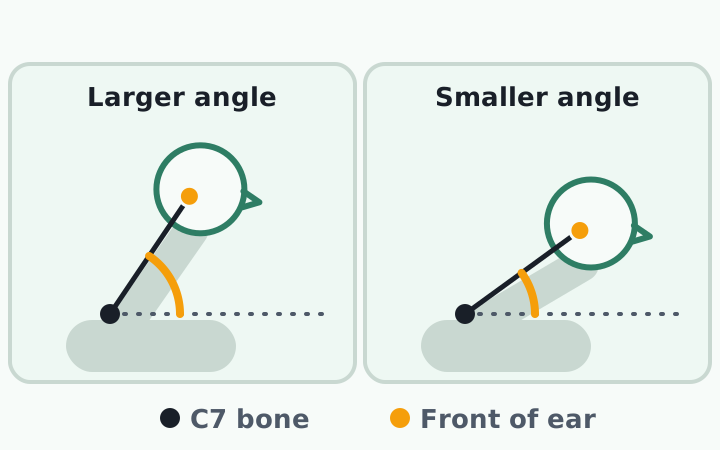
The link with pain is more consistent here than for the bone curve, but it is modest. A 2023 meta-analysis of 26 studies found that people with neck pain had a CVA about 2.9° smaller on average than people without pain.9 A 2019 meta-analysis of 15 studies found a difference in adults but not in adolescents.8
Studies that looked only at phone posture tell a different story. A Brazilian team measured how far 582 adults aged 18 to 65 bent their necks while texting. The angle was not associated with having neck pain, how often it occurred, or how bad it was.10
A long-term study points the same way. In an Australian cohort of 686 people, sitting neck posture at age 17 was not a risk factor for persistent neck pain at 22 in males. In females, the more relaxed postures were linked with lower odds of pain than upright sitting.11
You have probably seen the claim that tilting your head 60° puts 60 pounds on your neck. It comes from a 2014 paper by Kenneth Hansraj, a spine surgeon in New York: 10 to 12 pounds in neutral, 27 pounds at 15°, 40 at 30°, 49 at 45° and 60 at 60°.12 These figures were calculated in a computer (finite element) model of the cervical spine, not measured in people. Read them as a direction (more tilt, more load), not an exact weight.
Reversed curve and neck hump: two related terms
A reversed curve is the far end of military neck: the C now opens toward the front. Cleveland Clinic describes cervical kyphosis as a rare condition, with causes such as degenerative disc disease, ankylosing spondylitis, problems present at birth, injury and earlier spine surgery. It also notes that it does not always cause symptoms and that some straightening of the neck is normal with age.1 As the 32.1% figure above shows, mild reversed curves also turn up in people who feel fine.5
Severe cases are different. Trouble swallowing, unsteady walking, loss of fine hand control, or weakness, tingling or numbness in the arms and hands can mean that nerves or the spinal cord are under pressure.1
A hump at the base of the neck is something else again. Cleveland Clinic separates a dowager's hump, which is an increased forward curve of the upper back, from a buffalo hump, which is a pad of fat that can be a sign of excess cortisol. Candice Price, DC, a wellness and preventive medicine specialist there, says posture is the most common cause of a dowager's hump. Osteoporosis-related compression fractures are another, so the first step is finding the cause.14
Can you restore the neck curve? What is realistic
Many people search for ways to get the curve back. Changing the shape of the cervical spine is a clinical matter. Cleveland Clinic says physical therapy, such as neck exercises or traction, may ease pain and help restore a normal neck curve in mild cases, but it may not work for everyone. Surgery is considered when there is pain or neurological symptoms.1
What you can change at your desk is how long your head stays forward. Three things to check today:
- Take a side photo while you work. Is your ear well in front of your shoulder? This is a rough check, not a diagnosis.
- Set the top of your monitor at or slightly below eye level, 20 to 40 inches (50 to 100 cm) from your eyes.13
- Change position often: stand up and move your neck and shoulders.
For step-by-step help, see the text neck self-check, the guide to monitor and desk height, and a short neck stretch routine. A self-check cannot tell you whether you have military neck. Only an X-ray shows the curve, and a clinician decides whether that finding has anything to do with your symptoms.
See a doctor if you have pain that shoots down an arm, numbness or tingling in your hands, weakness, or trouble with balance or walking.1 The same goes for dizziness that does not go away. These are not posture questions.
One check worth adding to your routine: take a side-view photo before you start work and look at where your ear sits over your shoulder. A few photos taken at the same time of day show how your posture trends.
The label matters less than noticing the moment
Military neck describes a bone curve. Forward head posture describes a head position. The curve varies widely among people with no symptoms, and studies disagree on whether it causes pain. Head position is the part you can change during the day.
The hard part is that knowing is not enough. Once you are absorbed in work, your head drifts toward the screen and you do not feel it happen. So the practical job at your desk is to notice the moment your head moves forward and bring it back, until that becomes a habit.
RightPose AI is a desktop app for Windows and Mac built for that one job. Of the two things in this article, it checks the second one: where your head sits. You register your own upright and forward-head postures first, then at an interval you set (5 minutes by default) it uses your laptop or monitor webcam to check briefly and shows an on-screen alert when your head is forward. Camera images are processed on your device and are not sent off it.
If you want to start a better-posture routine today, begin by registering your own good posture.
RightPose AI is not a medical device. It is a habit tool that notices your posture and nudges you to reset and stretch.
FAQ
What does "straightening of the normal cervical lordosis" mean on an X-ray report?
It means the usual C-shaped curve of your neck looked flatter than expected in the side view. It describes a shape, not a disease. In a meta-analysis of 15,364 people without symptoms, about one in three did not have a lordotic curve.2 Ask the clinician who ordered the X-ray how the finding fits with your symptoms and exam.
Is military neck the same as tech neck?
No. Military neck refers to the bone curve seen on an X-ray.1 Tech neck and text neck are everyday names for forward head posture and the neck discomfort people link with screens. They are measured in different ways, so having one does not prove you have the other.
Can military neck be reversed?
Sometimes. For mild cases, Cleveland Clinic says physical therapy such as neck exercises or traction may ease pain and help restore a normal curve, though it does not work for everyone. Surgery, which aims in part to restore the shape of the spine, is considered when there is pain or there are neurological symptoms.1 Whether you need either depends on your symptoms and exam, not on the angle alone.
How is military neck diagnosed?
A provider asks about your history and symptoms, then examines your balance, movement, posture, reflexes and strength. Imaging such as an X-ray, CT scan or MRI shows the curve itself.1 A photo or a wall test cannot show the bone curve.
References
- Cervical Kyphosis
- Cervical lordosis in asymptomatic individuals: a meta-analysis
- Determining the relationship between cervical lordosis and neck complaints
- Modeling of the sagittal cervical spine as a method to discriminate hypolordosis
- The 3 Sagittal Morphotypes That Define the Normal Cervical Spine
- The association between cervical spine curvature and neck pain
- Roentgenographic findings of the cervical spine in asymptomatic people
- The Relationship Between Forward Head Posture and Neck Pain: a Systematic Review and Meta-Analysis
- Is Neck Pain Related to Sagittal Head and Neck Posture?: A Systematic Review and Meta-analysis
- Association Between Text Neck and Neck Pain in Adults
- Is Neck Posture Subgroup in Late Adolescence a Risk Factor for Persistent Neck Pain in Young Adults? A Prospective Study
- Assessment of stresses in the cervical spine caused by posture and position of the head
- Computer Workstations eTool: Monitors
- Dowager's Hump: What It Is and How To Get Rid of It
- The relationship between head posture and severity and disability of patients with neck pain
This article is for general information only and is not a substitute for medical diagnosis or treatment. If pain persists or worsens, consult a medical professional.