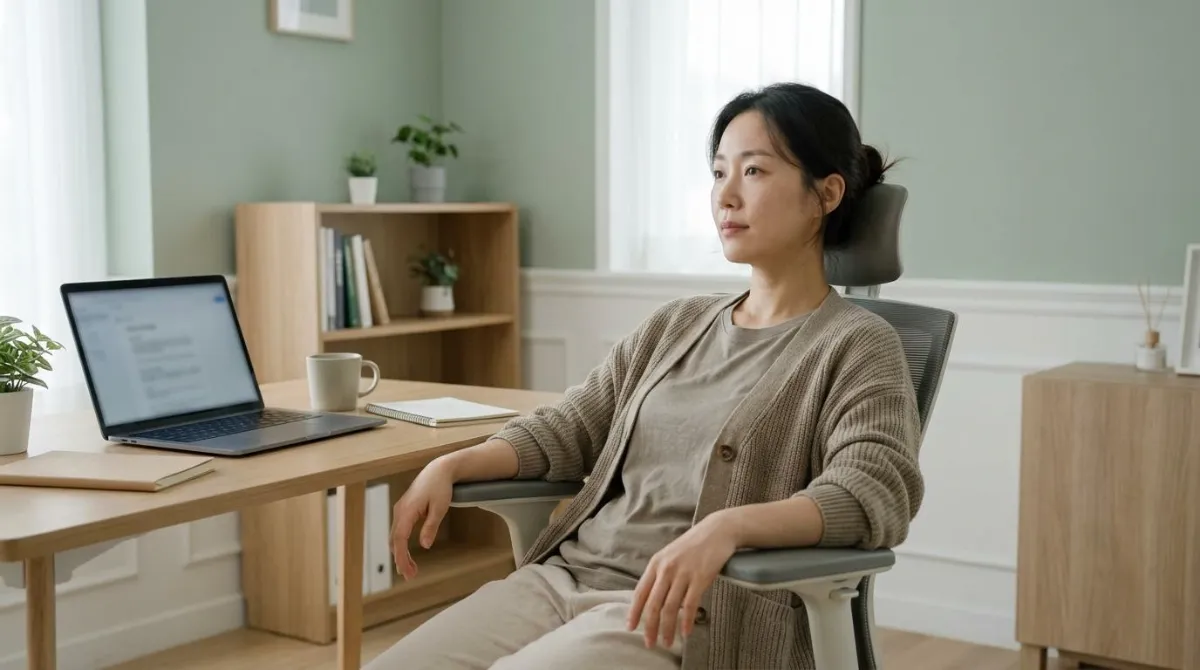
No, there isn't one perfect sitting posture. No single posture has been shown to prevent back or neck pain, and the professionals who teach posture don't agree on which one is best.12 What the evidence points to instead is time: staying in any one position for long stretches.
That doesn't make ergonomics useless. Guidance from OSHA and similar agencies still helps, but it describes a comfortable range, not a pose to hold all day.
What is good posture? Experts don't agree on one answer
Kieran O'Sullivan, a physiotherapy researcher at the University of Limerick in Ireland, and his colleagues showed 295 physiotherapists in four European countries nine photos of sitting postures, ranging from slumped to upright. Eighty-five percent chose one of two postures, and those two postures were very different from each other.2
The choice also varied by country. The authors concluded that disagreement remains on what a neutral spine is and on what the best sitting posture is.2 A 2019 survey of 544 Greek physiotherapists found the same pattern: their picks were spread across three different sitting postures.3
| Study | Who was asked | Result |
|---|---|---|
| O'Sullivan et al. 20122 | 295 physiotherapists, 4 European countries | 85% chose one of two very different postures |
| Korakakis et al. 20193 | 544 physiotherapists in Greece | Picks split across 3 of 7 sitting postures (97.5% combined) |
| Korakakis et al. 202116 | 100 people with no symptoms | None said their usual sitting posture was optimal |
There was common ground. The most popular choices were all some version of upright sitting with a curve in the low back, and slouched or forward head postures were almost never chosen. But the authors added that strong evidence linking any specific posture to better health outcomes is lacking.3
The public holds the same belief. When 100 people without symptoms were asked to show their optimal sitting posture, they consistently sat more upright than usual. Not one said their everyday posture was the optimal one.16
Does bad posture cause pain? What studies show and don't show
In 2019 the Journal of Orthopaedic & Sports Physical Therapy published a viewpoint titled "Sit Up Straight: Time to Re-evaluate." Its five authors include Peter O'Sullivan of Curtin University in Australia and Kieran O'Sullivan of the University of Limerick. They compared common posture beliefs with the evidence.1
Despite widespread beliefs about correct posture, there is no strong evidence that avoiding incorrect posture prevents low back pain, or that any single spinal curvature is strongly associated with pain.
Diane Slater and colleagues, Journal of Orthopaedic & Sports Physical Therapy, 2019
A broader look reached a similar place. Researchers in Australia and Germany gathered 41 systematic reviews on spinal posture, physical exposure, and low back pain. Some reviews found a link and others found none. Their conclusion was that there is no consensus on causality.4
| Study | Data | Finding |
|---|---|---|
| Swain et al. 20204 | 41 systematic reviews | No consensus that posture causes low back pain |
| Richards et al. 20215 | 686 Australians followed from age 17 to 22 | No link in males. In females, upright sitters had more persistent neck pain later |
| Mahmoud et al. 20196 | 15 cross-sectional studies | Adults with neck pain had more forward head posture. Adolescents did not |
| De Carvalho et al. 202015 | 10 studies with measured sitting time | 9 found longer sitting raised low back pain reports on the spot |
Reading this table as "posture doesn't matter" goes too far. In adults, forward head posture and neck pain did travel together.6 But these were one-time snapshots, so they can't show which came first. Pain can change how a person sits.
Here is the fair summary. There isn't enough evidence to say that bad posture causes pain. There is fairly consistent evidence that sitting for a long time makes your back feel worse while you sit.15 That is why attention has moved from the shape of your posture to how long you hold it.
What ergonomics guidelines still get right
Should you ignore advice about elbow angles and monitor height? No. Agency guidance doesn't name one right posture. It gives a comfortable range.
| Source | Sitting guidance | On holding one position |
|---|---|---|
| OSHA (US)7 | Elbows bent 90 to 120 degrees, thighs about parallel to the floor, back supported | The same posture for prolonged periods is not healthy, however good it is |
| CCOHS (Canada)8 | Hips, knees, and ankles at 90 degrees or slightly more | No single position is recommended. Don't sit more than 50 minutes at a time |
OSHA describes four reference postures, not one: upright sitting, standing, declined sitting with the seat tilted forward, and reclined sitting with the torso leaning back 105 to 120 degrees from the thighs. It calls all four neutral and tells you to change your working position frequently through the day.7
Canada's occupational health agency opens its sitting guidance by saying there is no single recommended body position. It advises changing positions often within the recommended ranges and adds that going outside those ranges now and then is acceptable.8 For the measurements themselves, see our guide to monitor, desk, and chair height.
Be careful with any claim built on one magic number. The idea that leaning back with a 135-degree angle between your torso and thighs is the best way to sit comes from a conference abstract presented at the Radiological Society of North America in 2006. It was an MRI study of 22 people without back pain.13 The group was small, and nobody followed people who actually worked at that angle to see how their backs felt.
Why your next posture matters more than your best one
You may have heard the line that your best posture is your next posture. We could not trace it to a study, but the research behind the idea is real. In 1999 Hans-Joachim Wilke and colleagues, aiming to update measurements from the 1960s, placed a pressure sensor in one volunteer's lumbar disc and recorded for about 24 hours.9
Relaxed standing measured 0.5 MPa. Sitting without back support measured 0.46 MPa. Slouched, relaxed sitting measured 0.3 MPa. Sitting bent fully forward was higher, at 0.83 MPa. The authors noted the limits of a one-person study, and they also concluded that constantly changing position is important for moving fluid and nutrients through the disc.9
A controlled trial tested this in an office. Researchers at Chulalongkorn University in Thailand assigned 193 office workers in Bangkok to three groups and followed them for six months. One group was prompted to take more short active breaks. One was prompted to shift posture more often while seated. The control group got a placebo seat pad and worked as usual.11
| Group | New neck pain | New low back pain |
|---|---|---|
| More active breaks (47 people) | 17% | 9% |
| More postural shifts (46 people) | 17% | 7% |
| Control (100 people) | 44% | 33% |
Shifting posture did about as well as taking breaks.11 The trial enrolled only workers judged to be at high risk of pain, most were women, and the groups used a device that prompted the behavior. You shouldn't expect a gap this large in every office.
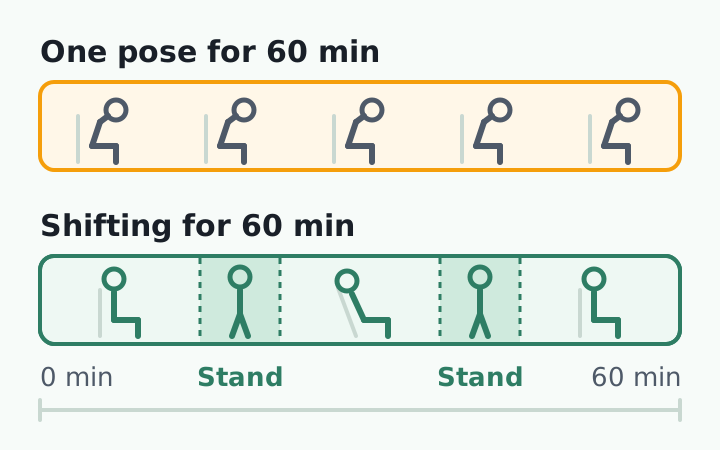
How often should you change? Sources differ. Cornell's ergonomics site suggests standing and moving for a couple of minutes about every 20 to 30 minutes, and says the exact timing isn't critical.10 We compare the common schedules in our desk break timing guide.
There is a caution from the other direction too. The JOSPT authors say encouraging people to move and change position can be helpful, but they ask clinicians not to spread worry that sitting in one position for more than 30 minutes is dangerous.1 Move when you notice you've been still.
The hard part is that posture drifts while your mind is on the work. In one study, 58 people with chronic neck pain did a 10-minute computer task. Their heads drifted forward by an average of 4.4 degrees over those 10 minutes. In ten people without pain, the change (2.2 degrees on average) was not significant.14 The task was built to distract them, and neck angle was measured every 2 minutes.
Posture assessments, ergonomic chairs, and posture clinics
If you're thinking about paying for posture correction, set your expectations by the evidence. The hope that changing how you look when you sit will make pain go away runs ahead of what studies show. Spinal curves vary naturally from person to person, and that variation alone doesn't explain pain.1
A posture assessment by eye is also less objective than it looks. In a study from the University of Saskatchewan, 28 clinicians, including physicians, physical therapists, and chiropractors, rated the neck and low back curves of 36 people from photos. Agreement between raters was poor, with a kappa of 0.16, where 1 means perfect agreement.12
Chairs deserve the same realism. A systematic review of five studies found that all five reported less pain right after a chair change, but rated the evidence only moderate, too thin for a strong recommendation.17 If you are shopping, our office chair criteria explain which adjustments matter.
Some situations do need a clinician. Even the JOSPT authors say that looking at posture has a role in spotting rare but important problems, such as a significant scoliosis that is getting worse.1
Cleveland Clinic advises seeing a healthcare provider for pain that doesn't get better on its own in a few weeks.18 Numbness, weakness in an arm or leg, dizziness, or a spine that looks visibly curved are also reasons to get checked. Don't assume it is only posture.
Three things to try at your desk today
Put the research and the guidelines together and the plan is simple. Know your comfortable range, move around inside it, and catch the moments when you've frozen.
- Pick one home position. Back against the backrest, feet flat on the floor, elbows bent 90 to 120 degrees, head level and in line with your torso.7 It is the place you come back to, not a pose to hold all day.
- Pick two or three alternates. Recline the backrest a little, move your feet, or do a task standing. If you cross your legs, switch sides now and then.8
- Move when you notice you've been still. If your head has crept toward the screen or your shoulders are up, return to your home position. Get up before you reach 50 minutes in the chair.8
Don't overdo the self-monitoring. Cleveland Clinic says there is no such thing as perfect or imperfect posture, and recommends checking in on your posture every once in a while instead of thinking about it constantly.18 To see where your head sits from the side, try our forward head posture self-check. A self-check is not a diagnosis.
Stop chasing the perfect pose and notice when you've frozen
Good posture is not one shape. Ergonomics guidance gives you a comfortable range, and the research suggests the bigger issue is staying in one spot within that range for too long.
Knowing this isn't enough. Deep in work, it is hard to tell how long your head has been pushed toward the screen. So the practical job at a desk is building the habit of noticing the moment your head drifts forward and bringing it back.
RightPose AI is a desktop app for Windows and Mac built for that noticing step. It does not hold you to a textbook pose. You register your own good posture first, and the app uses it as your baseline. It then uses your laptop or monitor webcam to take a quick look at set intervals (every 5 minutes by default) and shows an on-screen alert when your head has drifted into a forward head posture. Timed reminders to stand up and stretch give you a cue to break up a long spell in one position.
If you want better posture to become a daily habit, start by registering your own good posture after you install it. Then work as usual today, and you'll get an on-screen alert when your head has drifted toward the monitor.
RightPose AI is not a medical device. It is a habit tool that notices your posture and nudges you to reset and stretch.
FAQ
Is it bad to cross your legs when you sit?
Staying crossed on one side for a long time is the more likely issue. Canada's occupational health agency includes "alternate crossed legs" in its sitting recommendations, which means switching sides, not a ban.8 We did not find evidence in the sources we checked that crossing your legs changes the shape of your pelvis.
Is slouching bad for your back?
The evidence is weaker than the warnings suggest. In the one-volunteer disc pressure study, relaxed slouched sitting produced lower pressure than sitting upright without support.9 The JOSPT authors say more relaxed postures are safe to adopt.1 Agency guidance still lists "do not slouch," so the sources disagree.8 Slouching for hours without moving is the part worth changing.
Does a standing desk solve posture problems?
Standing is also one posture. Cornell's ergonomics site says simply standing is insufficient and that movement is what matters. It also notes that standing all day puts more strain on the legs, feet, and circulatory system.10 Alternating between sitting and standing, with some walking in between, is the better pattern.
Should I tell my kids to sit up straight?
The support for that advice is thin. An Australian study sorted 686 seventeen-year-olds by sitting posture from photos and followed them to age 22. In males, posture had no link to later persistent neck pain. In females, those who sat in more relaxed postures had lower odds than those who sat upright.5 It is one cohort, so it isn't the final word. Helping kids avoid long stretches in one position is closer to the evidence than correcting how they look.
References
- "Sit Up Straight": Time to Re-evaluate
- What do physiotherapists consider to be the best sitting spinal posture?
- Physiotherapist perceptions of optimal sitting and standing posture
- No consensus on causality of spine postures or physical exposure and low back pain: A systematic review of systematic reviews
- Is Neck Posture Subgroup in Late Adolescence a Risk Factor for Persistent Neck Pain in Young Adults? A Prospective Study
- The Relationship Between Forward Head Posture and Neck Pain: a Systematic Review and Meta-Analysis
- Computer Workstations eTool: Good Working Positions
- Working in a Sitting Position - Good Body Position
- New in vivo measurements of pressures in the intervertebral disc in daily life
- Sitting and Standing at Work
- Effects of an active break and postural shift intervention on preventing neck and low-back pain among high-risk office workers: a 3-arm cluster-randomized controlled trial
- Reliability of the visual assessment of cervical and lumbar lordosis: how good are we?
- The Way You Sit Will Never Be the Same! Alterations of Lumbosacral Curvature and Intervertebral Disc Morphology in Normal Subjects in Variable Sitting Positions Using Whole-body Positional MRI
- Effect of neck exercise on sitting posture in patients with chronic neck pain
- Association of Exposures to Seated Postures With Immediate Increases in Back Pain: A Systematic Review of Studies With Objectively Measured Sitting Time
- Notions of "optimal" posture are loaded with meaning. Perceptions of sitting posture among asymptomatic members of the community
- The effectiveness of a chair intervention in the workplace to reduce musculoskeletal symptoms. A systematic review
- Posture
This article is for general information only and is not a substitute for medical diagnosis or treatment. If pain persists or worsens, consult a medical professional.