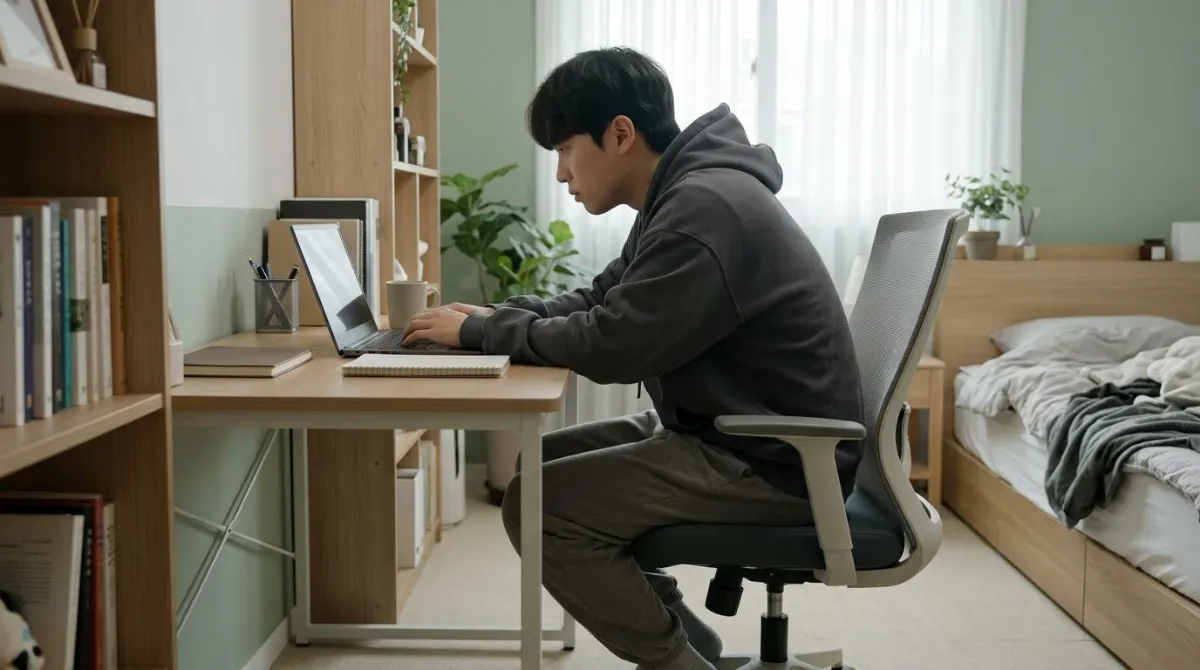
A hunched back from sitting is usually postural kyphosis. When you sit for long stretches, your pelvis tips backward, your lower back flattens, your upper back rounds, and your head drifts forward. This kind of curve is flexible: it straightens when you stand up tall or lie down.12
Not every rounded back is about posture, though. Structural kyphosis means the bones themselves have a different shape, as in Scheuermann's kyphosis in teens or compression fractures in older adults. Those curves stay put when you change position and need a medical evaluation.13
What counts as a hunched back? The numbers behind kyphosis
Your thoracic spine (the 12 vertebrae of your upper back) normally curves outward a little. Doctors measure that curve on a side X-ray using the Cobb angle. When it gets larger than normal, it's called hyperkyphosis, or just kyphosis.1
Where "normal" ends depends on who you ask. The Scoliosis Research Society (SRS), a group of spine deformity surgeons, puts the normal range at 10 to 45 degrees.1 Wendy Katzman, a physical therapist and researcher at the University of California, San Francisco, and her colleagues define hyperkyphosis as more than 40 degrees, the 95th percentile for young adults.4
| Group or cutoff | Angle | What it means |
|---|---|---|
| Average, childhood to late 20s | 20 to 29 degrees | Typical young adult curve4 |
| Common cutoffs | Over 40 or over 45 degrees | 40 is the young adult 95th percentile4; 45 is the SRS figure1 |
| Women aged 55 to 60 | 43 degrees on average | The curve starts growing after 40, faster in women4 |
| Women aged 76 to 80 | 52 degrees on average | About 20% to 40% of older adults exceed the cutoff4 |
The curve also grows with age. In a 2021 systematic review pooling data on 7,633 healthy adults, 65% had a curve above 40 degrees, and the authors warned that the 40-degree cutoff can misclassify people.5 Two other questions matter more: is the curve flexible, and are the vertebrae normally shaped?
Postural kyphosis vs. Scheuermann's and compression fractures
Postural kyphosis is the most common type. The American Academy of Orthopaedic Surgeons (AAOS) says it usually appears in the teen years and can often be undone when the person stands up straight.3
| Feature | Postural | Scheuermann's | Compression fracture |
|---|---|---|---|
| Vertebra shape | Normal rectangles1 | 3 or more in a row are wedge-shaped3 | Part of a vertebra is crushed16 |
| Typical onset | Teen years3 | Ages 12 to 15 in boys, 10 to 14 in girls1 | Adults, often with osteoporosis6 |
| Straightens when you lie down? | Yes7 | No7 | No, the bone shape stays1 |
| Next step | Check sitting habits and setup | Doctor visit and periodic X-rays1 | Doctor visit and bone health check1 |
Scheuermann's kyphosis happens when the front of the vertebrae grows more slowly than the back during growth spurts, creating wedges.1 Estimates of how common it is vary widely, from about 0.4% to 8% of people.78 Cleveland Clinic notes that changing your posture doesn't change this curve, because the vertebrae aren't flexible.9 In older adults, a rounding back can instead come from osteoporotic compression fractures, so a new hunch isn't always just posture.16
Three home checks (not a diagnosis)
- Stand against a wall. Can your heels, buttocks, upper back, and the back of your head touch it without strain?
- Lie on your back without a pillow. A curve that flattens points toward a flexible, postural curve.7
- Bend toward your toes while someone watches from the side. A sharp, angular hump is typical of Scheuermann's kyphosis.1
If your curve doesn't flatten lying down, or someone sees an angular hump, see a doctor. Only an X-ray of the vertebrae confirms whether a curve is postural or structural.1
How sitting rounds your back: it starts at the pelvis
Perch on the front of the seat or let your hips slide forward, and your pelvis tips backward. The lower back loses its inward curve, and the upper back rounds. Among 582 Spanish schoolchildren measured while slumped, a bigger upper-back curve went with more backward pelvic tilt (correlation 0.29).10
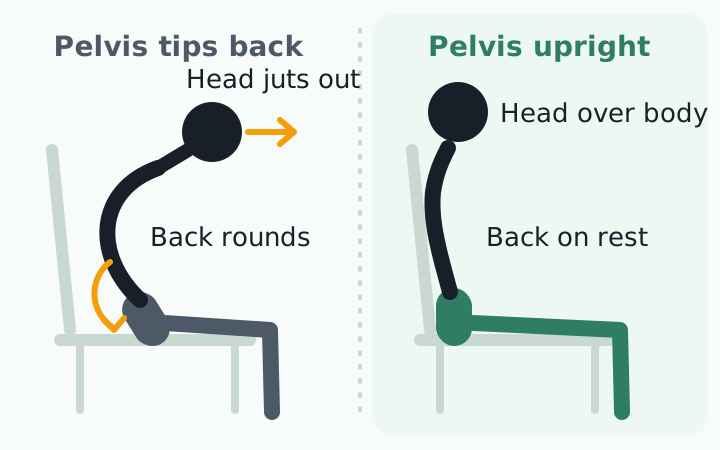
A Curtin University team in Australia that included physiotherapy researcher Peter O'Sullivan had 20 pain-free adults sit three ways: upright from the pelvis, upright through the chest only, and slumped.11 Slumping led to more head and neck flexion, a more forward head, and more activity in the muscles at the back of the neck.11
Forcing your chest up wasn't the answer either. In the same study, the chest-up posture increased activity in the upper-back muscles.11 Sitting tall from the pelvis with a relaxed chest was the easier middle ground, though a short lab test on 20 people can't speak for a full workday.
And we misjudge ourselves: in 17 pain-free people, usual sitting was clearly more slumped than the posture they considered ideal.12
Your chair and screen: 3 desk fixes for a rounded back
The backrest matters more than willpower. Classic experiments by a team including spine researcher Alf Nachemson found that disc pressure and back muscle activity both dropped when the back was supported, with backrest recline the most important factor.13
Sitting bolt upright isn't automatically better. Hans-Joachim Wilke's team at Ulm University in Germany measured pressure inside one 45-year-old man's lumbar disc. Slouching back in a chair gave 0.3 MPa, lower than sitting without a backrest (0.46 MPa).14 Consciously straightening his back pushed it to 0.55 MPa, about 10% above relaxed standing (0.5 MPa).14 It's one person's lower back, so treat it as a hint.
| What to check | OSHA guidance | Why it matters |
|---|---|---|
| Backrest | Fits your spine's curve, supports the low back, reclines at least 15 degrees15 | Support keeps the pelvis upright |
| Screen distance | 20 to 40 inches (50 to 100 cm) from your eyes16 | Too far and you lean forward, away from the backrest16 |
| Time in one position | Change positions often through the day17 | Long, still sitting adds up |
- Slide your hips all the way back. A backward pelvic tilt starts with your hips creeping forward.
- Fill the gap behind your lower back. If your chair has no lumbar support, OSHA suggests a rolled-up towel as a stopgap.15 Leaning back slightly into the backrest is easier than holding yourself up.13
- Put the screen where you can read it while leaning back. A screen that's too far pulls you forward, off the backrest.16 If you can't move it closer, enlarge the text.
Shopping for a new chair? The seat depth, backrest, and armrest criteria are in how to choose an office chair.
A small step for your daily routine: every time you sit down, push your hips all the way back before you start. It's the shortest way to stop the pelvis from tipping back.
Does a hunched back cause upper back pain? The evidence is mixed
The link is weaker than most people think. A 2008 systematic review co-authored by Jan Hartvigsen of the University of Southern Denmark looked at 54 studies and found no strong evidence that the shape of your spinal curves is associated with spinal pain.18
For the neck, a 2019 review of 9 studies found that a bigger upper-back curve goes with forward head posture, but not consistently with neck pain severity, and it couldn't be confirmed as a risk factor.19
The back muscles in a person with kyphosis have to work harder during sitting and standing and can become painful as they get tired. The bones themselves are not a cause of the pain.
Scoliosis Research Society, Spinal Deformity: Kyphosis patient handbook, 2018
A review of 10 studies with objectively measured sitting time linked long bouts to immediate increases in low back pain, but not to actual episodes of back pain.20 So watch how long you stay still, not just the shape of your back.
Rounded shoulders often come with a rounded upper back but have their own causes; see rounded shoulders from desk work.
Upper back stretches, exercises, and posture braces: what the research shows
Exercise can change the angle. A 2019 meta-analysis of 10 randomized trials found a large effect of exercise programs on thoracic kyphosis, and the authors suggested strengthening may matter more than stretching.21 Only 7 of those trials measured the kyphosis angle, though, and the authors said more research is needed to know which exercise works best.21
Katzman's team ran a 6-month trial with 99 adults aged 60 and older whose curves were 40 degrees or more, with therapist-led spine strengthening and posture training three times a week. The curve improved by 3.0 degrees more than in the control group, but physical function didn't differ.22
The SRS adds that postural kyphosis is natural for some people and typically can't be permanently straightened, though back exercises and posture awareness may help you sit and stand straighter.1
| Approach | What's been shown | Limits |
|---|---|---|
| Back strengthening | Kyphosis angle decreased2122 | No clear change in physical function22 |
| Chest and upper back stretching | Looks weaker than strengthening on its own21 | Few trials compare exercise types21 |
| Medical bracing | Used in growing teens with Scheuermann's to slow progression1 | Little role in postural kyphosis1 |
Thinking about a posture corrector? The bracing the SRS describes is a doctor-prescribed medical brace, not an off-the-shelf strap.1 For straps, see what to check before buying a posture corrector.
See a doctor if your back pain comes from between your shoulder blades, hasn't improved after a few weeks, or gets worse at night. The same goes if your back has changed shape, you've lost weight without trying, or you feel hot, cold, or shivery.23 Back pain after a fall, or noticing you've lost height, is also worth a proper medical check.
Sit back, reset often: the habit that outlasts posture advice
A rounded back more often comes from posture than from the shape of your bones. At a desk, a backward-tipping pelvis starts it, and your backrest and screen distance feed it or ease it. A curve that won't flatten lying down, or height loss, is a reason to see a doctor. Check three things at your desk today:
- Your hips are pushed all the way back in the seat
- Something fills the gap behind your lower back
- You can read the screen while leaning back
The catch is focus. Deep in work, your hips creep forward and your head drifts toward the screen, and your everyday posture is often more slumped than you think.12 So the most useful thing you can do at your desk is build a habit of noticing when your head has drifted forward and resetting.
RightPose AI is a desktop app for Windows and Mac. It uses your laptop or monitor webcam to check your posture at an interval you set (every 5 minutes by default) and shows an on-screen alert when it sees forward head posture. It doesn't measure your upper-back curve, but each alert is a cue to slide your hips back. Camera images are processed on your device and never leave it.
It also reminds you to stand up and stretch, with a follow-along stretching screen. RightPose AI is not a medical device. It is a habit tool that notices your posture and nudges you to reset and stretch.
If you're building a better daily routine, start by registering your own good posture and make sitting back a habit.
FAQ
Is a hunched back the same as scoliosis?
No. Kyphosis is a forward rounding you see from the side, while scoliosis is a sideways curve you see from the front or back.1 The AAOS says bad posture does not cause scoliosis; the scoliosis may be the reason for the poor posture instead.24 A sideways curve is confirmed on an X-ray.
Can a heavy backpack give you a hunched back?
According to the SRS, heavy backpacks don't cause permanent changes in the bones of the spine or kyphosis.1 They can make your back muscles sore, though.1 Using both straps and setting the bag down often is more comfortable than hauling it on one shoulder.
My teenager has a rounded back. Should we see a doctor?
Postural kyphosis often first appears in the teen years, and Scheuermann's shows up in the same window.13 See a doctor if the curve doesn't straighten when your teen stands tall, if there's an angular hump when they bend forward, or if back pain keeps coming back. Growing kids with kyphosis may get X-rays every 6 to 12 months.1
References
- Spinal Deformity: Kyphosis - A Handbook for Patients
- Kyphosis
- Kyphosis (Roundback) of the Spine
- Age-Related Hyperkyphosis: Its Causes, Consequences, and Management
- The relationship between thoracic kyphosis and age, and normative values across age groups: a systematic review of healthy adults
- Kyphosis
- Kyphosis
- Kyphosis
- Kyphosis: What It Is, Causes, Symptoms, Types & Treatment
- Sitting Posture, Sagittal Spinal Curvatures and Back Pain in 8 to 12-Year-Old Children from the Region of Murcia (Spain): ISQUIOS Programme
- The influence of different sitting postures on head/neck posture and muscle activity
- Neutral lumbar spine sitting posture in pain-free subjects
- The sitting posture: an electromyographic and discometric study
- New in vivo measurements of pressures in the intervertebral disc in daily life
- Computer Workstations eTool: Workstation Components - Chairs
- Computer Workstations eTool: Workstation Components - Monitors
- Computer Workstations eTool: Good Working Positions
- Spinal curves and health: a systematic critical review of the epidemiological literature dealing with associations between sagittal spinal curves and health
- Thoracic Posture and Mobility in Mechanical Neck Pain Population: A Review of the Literature
- Association of Exposures to Seated Postures With Immediate Increases in Back Pain: A Systematic Review of Studies With Objectively Measured Sitting Time
- Effects of exercise programs on kyphosis and lordosis angle: A systematic review and meta-analysis
- Targeted spine strengthening exercise and posture training program to reduce hyperkyphosis in older adults: results from the study of hyperkyphosis, exercise, and function (SHEAF) randomized controlled trial
- Back pain
- Scoliosis Overview
This article is for general information only and is not a substitute for medical diagnosis or treatment. If pain persists or worsens, consult a medical professional.