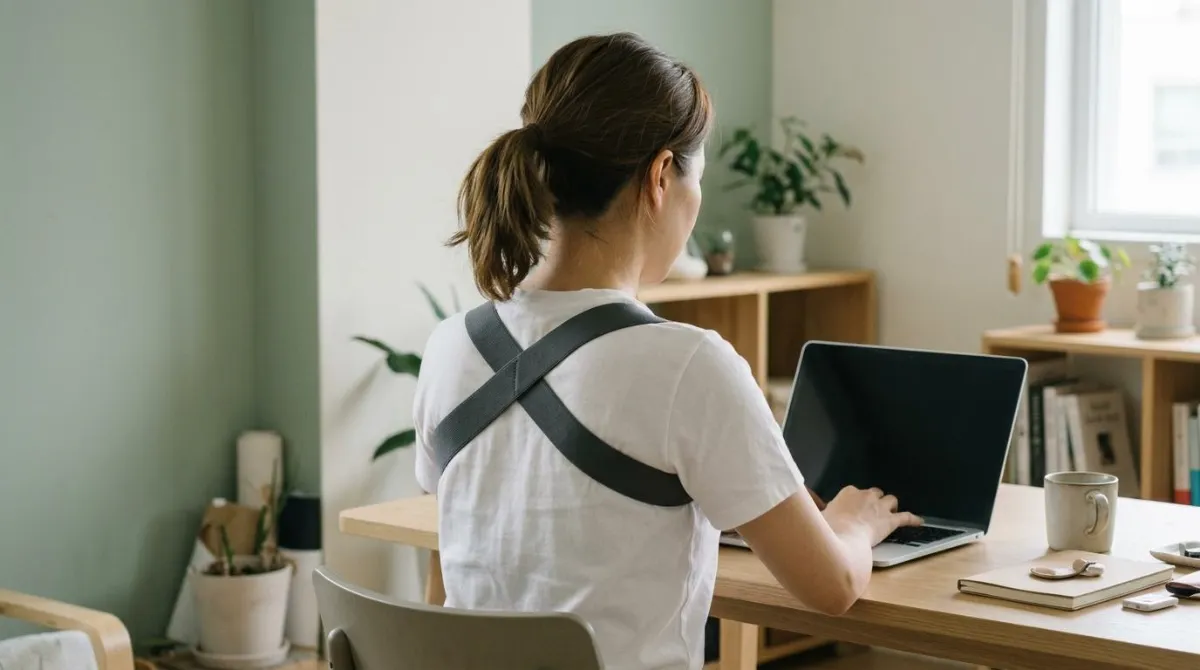
Do posture correctors work? They change where your shoulders sit while you have one on. Lab studies show that much. Whether your posture stays changed after you take it off, or whether your neck and back hurt less, has not been shown.1
That does not make every posture brace useless. It means the product does a narrower job than the packaging suggests, and knowing that job helps you choose.
Two kinds of posture corrector: ones that hold and ones that remind
The names vary, but the mechanisms come down to two. One kind uses straps or fabric tension to hold your shoulders and upper back from the outside. The other kind measures how far you lean and only sends a signal, a buzz or an on-screen alert.
| Type | What it does | Mechanism |
|---|---|---|
| Figure-8 strap or shoulder brace | Pulls both shoulders back | Holds |
| Vest or back-panel brace | Supports the upper back and shoulders | Holds |
| Posture shirt or bra | Pulls the shoulders with fabric tension | Holds |
| Wearable posture sensor | Tracks tilt and vibrates when you slouch | Reminds |
| Posture app | Checks posture with a camera or sensor and alerts you on screen | Reminds |
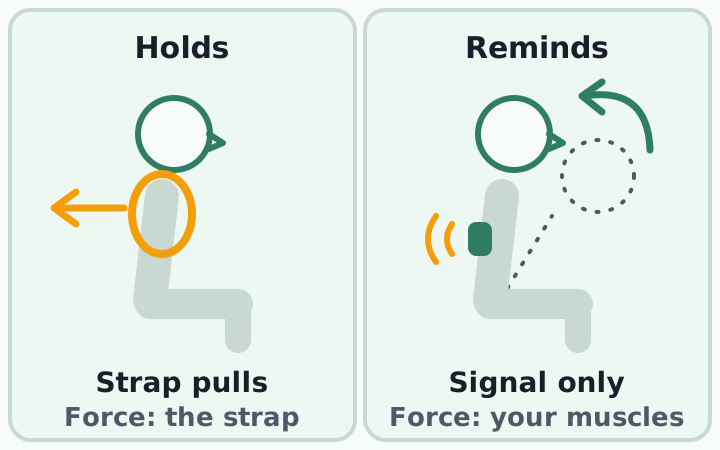
Christina Rodriguez, an orthopedic physical therapist at Hospital for Special Surgery (HSS) in New York, explains the idea through proprioception, your body's sense of where it is in space. When you start to slouch, the device tells you that you are out of position, and you pull your shoulders back yourself.8
Think of it like training wheels; everyone will be different in terms of how long they want to use it.
Christina Rodriguez, PT, DPT, Hospital for Special Surgery, 2021
Do posture braces work? What the trials measured
Few studies have put a shoulder brace on people and measured what happened. Most looked at the minutes right after the brace went on.
| Study | Who | Result |
|---|---|---|
| Cole et al. 20132 | 38 overhead athletes with forward head and rounded shoulders | Forward shoulder angle decreased with straps tightened. Muscle activity changes varied widely |
| Ko et al. 20163 | 15 men with forward shoulder posture | Less forward tilt of the shoulder blade right after a figure-8 strap went on. No change in muscle activity |
| Leung et al. 20234 | 30 healthy university students, 30 minutes of typing | Lower trapezius worked less. No difference in neck alignment, pain, or fatigue |
| Palsson et al. 20191 | 6 studies of posture shirts (review) | Posture changed. All 6 studies used pain-free people |
The study closest to desk work comes from Hong Kong Polytechnic University. Thirty healthy students typed on a laptop for 30 minutes with a scapular brace and 30 minutes without. With the brace, the lower trapezius was less active. Rounded shoulders looked slightly better, but not significantly so, and neck alignment, pain, and fatigue did not differ.4
That matters if you want a posture corrector for tech neck. In this trial, a brace that pulled the shoulders did not move the head. It was one 30-minute experiment, so it does not prove a brace cannot help.
Thorvaldur Palsson and colleagues at Aalborg University in Denmark searched for studies of posture-correcting shirts and found six to review. The shirts changed posture, and wearers reported less discomfort and more energy. But study quality was mostly poor to fair, so the team rated confidence in the evidence as very low. Every study enrolled people who had no pain.1
If you're trying to push something that will correct your posture and will give you pain relief and improve your function, you should be including people that have those problems in the first place to make sure that you're creating a change.
J.P. Caneiro, physiotherapist and research fellow, Curtin University (co-author of the review), in Consumer Reports, 2023
Do posture correctors weaken muscles? Where wear-time advice comes from
You will read that wearing a brace too long makes your muscles lazy. Clinicians do worry about this. UCLA Health says long-term wear can potentially weaken muscles.10 Eugene Wai, a spine surgeon at the University of Ottawa, told Consumer Reports that people may come to depend on a brace, which could make existing weakness worse.9
We could not find a study that put people in a shoulder brace for weeks and then measured strength. The nearest evidence is on lumbar supports. Researchers at Saitama Prefectural University in Japan pooled eight studies and found no loss of trunk strength or endurance after 1 to 6 months of continuous use. They also rated the quality of that evidence as low to very low, so the question is not settled.7
So muscle weakening is a reasonable concern, not an established fact. The Hong Kong trial did show muscles working less while the brace was on.4 Nobody has measured whether that turns into weaker muscles months later. Wear-time advice sits on the same footing.
| Source | Suggested wear time | Basis |
|---|---|---|
| Christina Rodriguez, HSS8 | A few hours a day at most. Not in bed. Not permanently | Clinical opinion |
| Mayur Jivanjee, physiotherapist, Melbourne9 | Not all day, and no more than 1 to 2 hours at a time | Clinical opinion |
| Trials comparing wear times | None found | None |
In other words, "a few hours a day" is a cautious rule of thumb, not a number from an experiment. Follow the limits in the product instructions, start short, and see how your body responds. Rodriguez also recommends pairing the device with exercises that strengthen your postural muscles.8
Do vibrating posture trainers have better evidence?
A reminder device does not pull on you. Your own muscles do the work of sitting back up, so dependence on a strap is not the issue. That does not mean the evidence is stronger.
Researchers at National Cheng Kung University in Taiwan tested a commercially available biofeedback device on 21 adults with chronic neck pain during a 1-hour typing task. With feedback on, neck flexion decreased and the neck extensor muscles were less active. Neck pain rose over the hour whether the device was on or off.5
A 2024 review from Karolinska Institutet in Sweden gathered 16 studies of wearable sensors that gave posture feedback. In controlled settings, the evidence ranged from strong to none depending on how much time had passed since the feedback. In real workplaces, it ranged from very limited to none.6
Most of this research used sensors attached to the body. Camera-based posture apps have been studied even less. So compare posture tools by how they work, not by which one claims the bigger effect.
| Aspect | Holds | Reminds |
|---|---|---|
| Force that changes posture | Strap tension | Your own muscles |
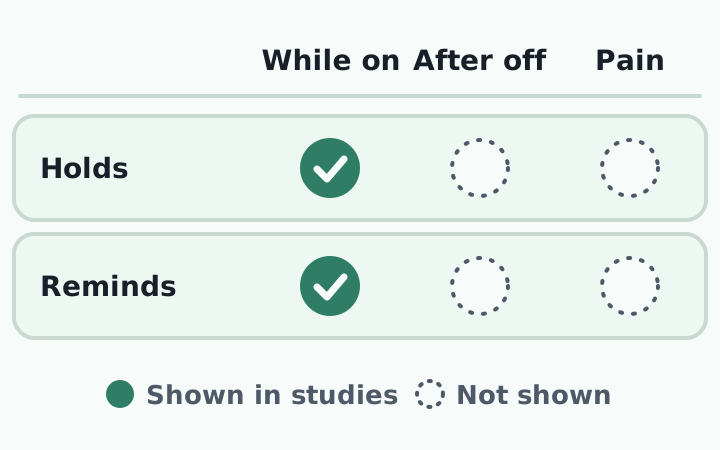
| Shown in studies | Shoulder position while worn23 | Neck and back angles while alerts are on5 |
| Not shown | Posture after removal, pain1 | Posture after alerts stop, pain6 |
| Common annoyances | Tightness, chafing, heat | Frequent alerts, charging or attaching |
| May suit you if | You need to feel a tug to notice your posture | You dislike being strapped in and want to practice straightening yourself |
What to check before you buy a posture corrector
There is no data showing which type works best.8 That makes brand less useful than a short list of checks.
- Does it pull where your problem is? Braces for rounded shoulders and braces for the upper back are built differently8
- Can you put it on, adjust it, and take it off without help?8
- Is the material breathable, free of chafing, and not so rigid that it locks you in place?8
- Do the instructions state a wear time and who should not use it?
- Does the listing promise pain relief or a permanent change? Studies do not support either claim1
- Have you decided what you will do when it is off: exercises and a desk setup that fits you?
A note on US regulation. FDA classifies devices intended to support or immobilize fractures, strains, or sprains of the neck or trunk as truncal orthoses, a Class I category exempt from premarket notification.11 So a brace sold under that category reaches the market without FDA reviewing evidence that it changes posture.
What you do without the brace has more research behind it. A 2026 meta-analysis pooled 28 randomized trials with 901 participants and found that corrective exercise produced large changes in forward head angle, forward shoulder angle, and upper-back curve. Effects on pain and function were inconsistent.12 See neck strengthening exercises and rounded shoulders at a desk.
The premise that bad posture causes pain is also weaker than most ads assume. In a 2019 viewpoint in the Journal of Orthopaedic & Sports Physical Therapy, five physiotherapy researchers wrote that a large posture industry has flourished despite the absence of strong evidence that sitting or standing "incorrectly" causes spinal pain.13
If your monitor sits low, your head follows it down no matter what is strapped to your shoulders. See monitor, desk, and chair height for the numbers.
See a doctor instead of relying on a brace if you have numbness or weakness in an arm or hand, pain that gets worse at night, or dizziness that does not go away. The same applies if your upper back has rounded suddenly or you have lost height.
Whatever you choose, set a daily rule before you start, like how long you'll wear it or how many reminders you want. With a baseline, you can decide whether to keep going.
Whether it holds or reminds, the last step is yours
A brace changes shoulder position while you wear it. Evidence that it changes posture afterward, or reduces pain, is not there yet, and the same is true of vibrating sensors. Whichever you pick, what the tool gives you is a signal that your posture has slipped.
The hard part is the time with no signal. When you are absorbed in work, you rarely notice the moment your head drifts toward the screen. So the practical job at a desk is building the habit of noticing that moment and resetting.
RightPose AI belongs on the reminder side. It is a desktop app for Windows and Mac, not something you wear. It uses your laptop or monitor webcam to check your posture briefly at a set interval (every 5 minutes by default) and shows an on-screen alert when your head has moved forward. The reference is your own upright posture, which you register at the start. Nothing pulls on you, so the reset is yours to do, and the app shows your image with joint lines so you can see what to adjust.
The two approaches differ, and neither is right for everyone. If you need physical contact to notice your posture, or you work on your feet, something you wear may suit you. If you spend most of the day at a screen and dislike being strapped in, an on-screen alert may suit you.
Whichever way you go, the first step is knowing your own good posture. Start by registering it in RightPose AI.
RightPose AI is not a medical device. It is a habit tool that notices your posture and nudges you to reset and stretch.
FAQ
Can you sleep in a posture corrector?
It is not recommended. Rodriguez at HSS says to use a posture corrector during daily activities and not to wear one to bed.8 If the device works by prompting you to straighten up, it has little to offer while you are asleep.
Is a posture corrector the same as a scoliosis brace?
No. A brace for adolescent idiopathic scoliosis is prescribed by a doctor and has its own evidence. In a multicenter study of 242 patients led by US researchers, 72% of those who wore a brace reached skeletal maturity without their curve progressing to the surgical threshold, compared with 48% of those who were only observed.14 That result does not transfer to an over-the-counter shoulder strap.
Is a posture brace a good idea for an older parent with a rounded upper back?
Get the cause checked first. About one in four women aged 50 and older has at least one vertebral fracture.15 In a German trial, women with osteoporotic vertebral fractures who wore a medical spinal orthosis for 6 months had 73% more back extensor strength and an 11% smaller kyphosis angle. That was a prescribed orthosis, not a retail posture strap.15
Does bad posture actually cause back and neck pain?
The evidence is mixed. Eugene Wai of the University of Ottawa told Consumer Reports, "I don't think we have good evidence about bad posture leading to chronic back pain."9 The 2019 JOSPT viewpoint makes a similar point about spinal pain in general.13 Staying in any one position for hours is a separate issue, and moving regularly is a reasonable response to it.
References
- The use of posture-correcting shirts for managing musculoskeletal pain is not supported by current evidence - a scoping review of the literature
- Scapular bracing and alteration of posture and muscle activity in overhead athletes with poor posture
- Figure-8 Strap Application: Immediate Alteration of Pectoralis Minor Length and Scapular Alignment During Arm-Lifting Exercise in Participants With Forward Shoulder Posture
- Effects of Using a Shoulder/Scapular Brace on the Posture and Muscle Activity of Healthy University Students during Prolonged Typing-A Randomized Controlled Cross-Over Trial
- Immediate effects of real-time postural biofeedback on spinal posture, muscle activity, and perceived pain severity in adults with neck pain
- A Rapid Review on the Effectiveness and Use of Wearable Biofeedback Motion Capture Systems in Ergonomics to Mitigate Adverse Postures and Movements of the Upper Body
- The impact of continuous use of lumbosacral orthoses on trunk motor performance: a systematic review with meta-analysis
- Do Posture Correctors Work? Plus Expert Tips on How to Use Them
- Are Posture Correctors Useful?
- Why good posture matters
- 21 CFR 890.3490 Truncal orthosis
- Corrective exercises strongly improve posture but fail to produce consistent clinical or functional benefits in patients with upper crossed syndrome: a systematic review and meta-analysis of randomized controlled trials
- "Sit Up Straight": Time to Re-evaluate
- Effects of bracing in adolescents with idiopathic scoliosis
- Effects of a new spinal orthosis on posture, trunk strength, and quality of life in women with postmenopausal osteoporosis: a randomized trial
This article is for general information only and is not a substitute for medical diagnosis or treatment. If pain persists or worsens, consult a medical professional.