
The chin tuck exercise is a small, slow glide of your head straight back, held for a few seconds. It targets the deep neck flexors, the muscles in front of your spine that help hold your head over your shoulders. In a pooled analysis of 10 trials, people in exercise programs for forward head posture had less neck pain than control groups, and their head position angle improved by about 3 degrees on average.6
That is a modest change, and the certainty of the evidence is low to moderate.6 This guide covers four exercises, the reps hospitals and trials use, and what the research shows. For stretches rather than strength work, see neck stretches you can do at your desk.
Why the chin tuck exercise targets the deep neck flexors
Your deep neck flexors (longus colli and longus capitis) sit against the front of the spine. Gwendolen Jull and colleagues at The University of Queensland in Australia developed the craniocervical flexion test to assess them. Their summary of the research: people with neck pain show less activity in the deep flexors and more in the surface muscles.3
That finding shapes the exercises. The goal is not to push hard. It is to use the right muscles at low effort, then build endurance. In a 6-week trial of 46 people with chronic neck pain, low-load nodding raised deep flexor activity and lowered surface muscle activity. Conventional neck strengthening did not change deep flexor activity.4
| Exercise | Main target | Typical dose | Source |
|---|---|---|---|
| 1. Seated chin tuck | Deep neck flexors | 3 to 5 s hold x 10 | Harvard Health17 |
| 2. Supine nod | Deep neck flexors | 10 s hold x 10 | Clinical trial13 |
| 3. Isometric holds | Muscles around the neck | 6 s hold x 8 to 12 | Kaiser Permanente18 |
| 4. Shoulder blade squeeze | Muscles between the shoulder blades | 3 sets of 10 | Cleveland Clinic19 |
No trial has tested these four as one package. The table gathers doses used separately.
How to do a chin tuck and a supine nod
1. Seated chin tuck (neck retraction)
Sit tall and look straight ahead. Glide your head straight back, as if making a double chin, without tipping it up or down. Harvard Health's version is to hold for three to five seconds, release, and repeat 10 times.17 Meghan Homoky, a physical therapist at Hospital for Special Surgery in New York, suggests a 5-second hold whenever you catch yourself slouching or craning.20
2. Supine nod (craniocervical flexion)
This is the movement clinical trials have used to retrain the deep neck flexors.3 Lying down takes away the weight of your head, so the surface muscles have less reason to take over.
- Lie on your back with your knees bent. Rest the back of your head on a folded towel so your neck is neutral.
- Place your tongue on the roof of your mouth, lips together, teeth slightly apart.21
- Nod slowly as if saying "yes," moving only about 2 cm.21
- Keep the back of your head on the towel and hold for 10 seconds.
- Relax and repeat 10 times.13
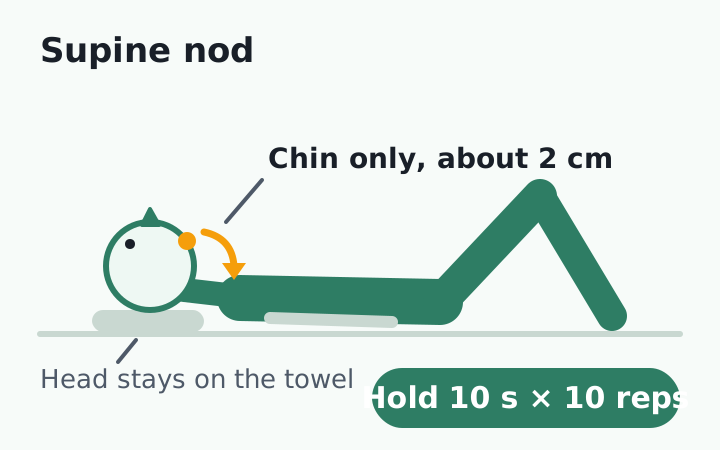
Two common mistakes are lifting your head off the floor and pulling your chin down hard. If the long muscles at the front and side of your neck stand out, make the nod smaller. In the trial that used this dose, participants stayed in a range that did not tighten the surface muscles or provoke pain.13
Isometric holds and shoulder blade squeezes
3. Isometric holds
Your head does not move in this one. Place your hand on your forehead, then the back of your head, then each side, and press head and hand against each other. Kaiser Permanente's instruction is to press firmly, but not as hard as you can, hold for about 6 seconds, and repeat 8 to 12 times.18
4. Shoulder blade squeeze
Let your arms hang. Draw your shoulder blades together and slightly down, without shrugging. Candice Price, DC, a wellness and preventive medicine specialist at Cleveland Clinic, recommends three sets of 10 daily, paired with chin tucks.19
Why include the shoulders? A Cochrane review of 27 trials found moderate-quality evidence that strengthening the neck, shoulder blade, and arm muscles reduces chronic neck pain. It also found that stretching alone may not change pain or function.9
How many reps, and for how many weeks?
Doses differ by source.
| Source | Exercise | Dose |
|---|---|---|
| Harvard Health17 | Neck retraction | 3 to 5 s x 10, daily at first, later a few times a week |
| Kaiser Permanente18 | Isometric holds | 6 s x 8 to 12 |
| Cleveland Clinic19 | Chin tucks, scapular squeezes | 3 sets of 10 daily |
| 2024 clinical trial13 | Supine nod | 10 s x 10, twice daily, 6 weeks |
| Same trial13 | McKenzie neck retraction | 10 reps, 6 sets a day, 6 weeks |
Six weeks is the most common trial length for deep neck flexor training.45 A Danish trial of strength training for a painful trapezius muscle ran 10 weeks, and worst pain fell by 35 mm on a 100-mm scale.12 A Finnish trial of 180 female office workers with chronic neck pain ran 12 months, and both the strength and endurance groups ended with less pain and disability than controls.11
A 2026 meta-analysis saw a trend toward larger changes in programs of 8 weeks or more and in programs combining exercise types, but called those findings exploratory.6 A reasonable plan is light exercises daily for at least 6 to 8 weeks. To track change, take a side-view photo under the same conditions each time. A self-check is a reference, not a diagnosis.
Do these exercises fix forward head posture?
Researchers measure forward head posture with the craniovertebral angle (CVA). It is the angle between a horizontal line and a line from the base of the neck (the C7 vertebra) to the ear. The farther forward your head sits, the smaller the angle.
| Study | Who | Result |
|---|---|---|
| Xing et al. 2026, meta-analysis6 | Forward head posture with neck pain, 10 trials, 550 people | CVA up 3.38 degrees on average, pain score down 1.42 points |
| Javdaneh et al. 2026, meta-analysis7 | Chronic neck pain, 25 trials, 1,166 people | Nodding exercise improved pain, function, and CVA, but findings are "suggestive rather than definitive" |
| Khorramroo et al. 2026, meta-analysis8 | Upper crossed syndrome, 28 trials, 901 people | Large posture changes, with pain and function inconclusive |
| Falla et al. 20075 | 58 people with chronic neck pain, 6 weeks | Less forward drift of the head during computer work |
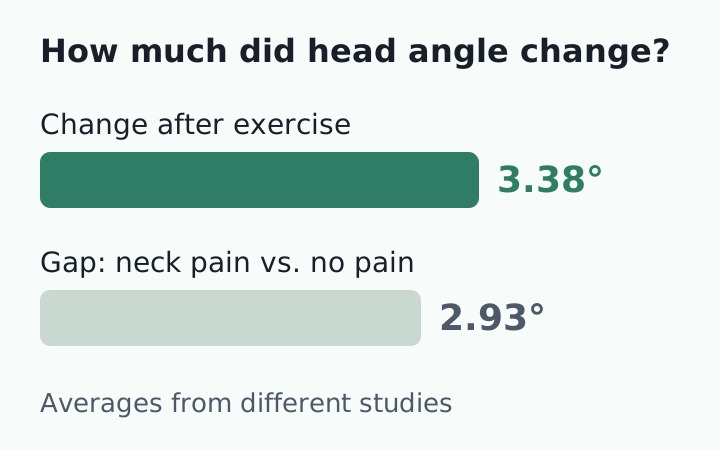
How big is 3.4 degrees? In a pooled analysis of 26 studies, people with neck pain had a CVA 2.93 degrees smaller than people without pain.10 The average change from exercise is about the size of that gap, but no one has established how many degrees count as meaningful.13
Posture and symptoms do not always move together. In one 2026 meta-analysis, corrective exercise changed posture angles substantially, yet results for pain and function were inconclusive.8 The Cochrane review supports strengthening for pain, but it also states that no high-quality evidence was found.9
Deep neck flexor training is not clearly better than other exercise, either. Across 12 trials it did slightly better in the short to medium term, with no long-term difference and low certainty.14 It improves coordination but does little for strength at higher loads, so reviewers suggest mixing methods.15
This study showed that people with chronic neck pain demonstrate a reduced ability to maintain an upright posture when distracted.
Deborah Falla and colleagues, Aalborg University and The University of Queensland, Physical Therapy, 2007
In that study, participants did a 10-minute computer task. The neck pain group drifted 4.4 degrees forward, while the pain-free group's 2.2-degree change was not significant. After 6 weeks of nodding exercise, that drift was smaller.5
McKenzie exercises, arm symptoms, and when to stop
McKenzie neck exercises are often thought of as bending backward. The most-used movement, though, is neck retraction: the head moves straight back without tilting and ends where a chin tuck ends. A 2024 trial at Chulalongkorn University in Thailand compared McKenzie exercise with supine nodding in 40 people with chronic neck pain. After 6 weeks both groups improved in strength, pain, disability, and CVA, with no difference between them.13
In that trial, neck extension was added only for people who could fully retract without pain.13 A 2026 meta-analysis of 8 trials (389 people) concluded that McKenzie-based exercise brought small, short-term improvements in pain and disability, with low certainty.16
Pain, tingling, or numbness running down an arm is a different situation. For chronic neck pain with radiating pain, the 2017 clinical practice guideline from the orthopaedic section of the American Physical Therapy Association recommends intermittent traction combined with stretching, strengthening, and neck and upper back mobilization or manipulation.1 That is a standard for physical therapists, not a home routine.
A meta-analysis of 10 trials (871 people) with cervical radiculopathy found exercise may help, but rated the evidence as low and advised choosing exercises carefully for each patient.2 Here is how posture-related neck pain differs from a herniated disc.
Stop the exercise if any of the following happens.
- Numbness or tingling in your arm or hand during or after exercise
- Weakness in your arm or hand
- Dizziness
- Pain that spreads farther down the arm as you repeat the movement
- Neck pain that began after a fall or an accident
If arm pain, numbness, weakness, or dizziness continues, do not push through it with exercise. See a doctor or physical therapist. Harvard Health's guidance is to seek professional help if neck pain lasts more than two weeks.17 These exercises are general health information, not a diagnosis or a treatment plan. Read more on when to see a doctor for neck pain.
To make these part of your daily routine, attach them to something you already do every day, like right after brushing your teeth or after lunch. Linking to an existing habit makes them harder to forget.
Exercise takes minutes. The rest of the day decides your posture
To sum up, these four exercises train the deep neck flexors and the muscles around the shoulder blades. In trials, exercise programs like these reduced neck pain and improved head position by about 3 degrees on average, though the certainty is not high.
What remains is the time you are not exercising. Exercise takes a few minutes. Desk work takes hours. As the computer-task study showed, your head drifts forward while your attention is on the screen, and you rarely notice. So the practical job at your desk is building the habit of noticing the moment your head drifts forward and bringing it back.
RightPose AI is a desktop app for Windows and Mac that helps with the noticing. It uses your laptop or monitor webcam to check your posture briefly at a set interval (5 minutes by default) and shows an on-screen alert when it sees forward head posture. That alert is your cue for one chin tuck. You also see yourself on screen with joint lines drawn in, so you can watch your head come back over your shoulders.
If exercise is already part of your routine, let RightPose AI catch the moments your head drifts forward during work. Start by registering your good posture.
RightPose AI is not a medical device. It is a habit tool that notices your posture and nudges you to reset and stretch.
FAQ
How often should I do chin tucks?
Sources vary. Harvard Health suggests 10 reps daily at first, then a few times a week.17 Cleveland Clinic suggests three sets of 10 daily.19 In a 2024 trial, people doing McKenzie-style retraction did 10 reps every two hours.13 Start at the low end, and stop if pain follows.
Is light exercise or heavy strengthening better for neck pain?
They do different jobs. In a 12-month Finnish trial, high-intensity isometric strength training and lighter endurance training both reduced pain and disability compared with controls.11 Low-load nodding is good at changing how the deep muscles are recruited, but has little effect on strength at higher loads.15 Starting light and adding holds or resistance later is a sensible order.
Will my posture go back if I stop exercising?
Long-term data are thin. The McKenzie meta-analysis found no trials reporting medium or long-term outcomes16, and deep neck flexor training showed no long-term advantage over other exercise.14 In the 12-month trial, people who kept training had less pain and disability at the end.11 So far, benefits are documented mainly while people keep exercising.
Is it normal for my neck to crack during these exercises?
Meghan Homoky, a physical therapist at HSS, says crackling sounds during neck circles are normal as long as there is no pain with them.20 If the sound comes with pain or numbness, stop and get it checked.
Can teenagers do these exercises?
A review of three randomized trials in adolescents and young adults without musculoskeletal conditions found that all three programs used the supine chin tuck, and two used scapular retraction.22 That is only three trials. If a teenager has neck pain, a medical visit comes first.
References
- Neck Pain: Revision 2017. Clinical Practice Guidelines Linked to the International Classification of Functioning, Disability and Health From the Orthopaedic Section of the American Physical Therapy Association
- The effect of exercise on cervical radiculopathy: A systematic review and meta-analysis
- Clinical assessment of the deep cervical flexor muscles: the craniocervical flexion test
- The effect of therapeutic exercise on activation of the deep cervical flexor muscles in people with chronic neck pain
- Effect of neck exercise on sitting posture in patients with chronic neck pain
- Therapeutic Exercise for Forward Head Posture in Neck Pain Patients: A Systematic Review and Meta-Analysis
- The effect of craniocervical flexor exercise on chronic neck pain: a systematic review and meta-analysis
- Corrective exercises strongly improve posture but fail to produce consistent clinical or functional benefits in patients with upper crossed syndrome: a systematic review and meta-analysis of randomized controlled trials
- Exercises for mechanical neck disorders
- Is Neck Pain Related to Sagittal Head and Neck Posture?: A Systematic Review and Meta-analysis
- Active neck muscle training in the treatment of chronic neck pain in women: a randomized controlled trial
- Effect of two contrasting types of physical exercise on chronic neck muscle pain
- McKenzie neck exercise versus cranio-cervical flexion exercise on strength and endurance of deep neck flexor muscles, pain, disability, and craniovertebral angle in individuals with chronic neck pain: a randomized clinical trial
- Effectiveness of Specific Neck Exercise for Nonspecific Neck Pain; Usefulness of Strategies for Patient Selection and Tailored Exercise-A Systematic Review With Meta-Analysis
- Effects of deep cervical flexor training on impaired physiological functions associated with chronic neck pain: a systematic review
- Effectiveness of the McKenzie-based exercises in improving pain, disability, and cervical range of motion in patients with chronic non-specific neck pain: A systematic review with meta-analysis
- Do habits cause your neck pain?
- Neck: Exercises
- Dowager's Hump: What It Is and How To Get Rid of It
- 5 Ways to Relieve Your Neck Pain, from a PT
- Neck Pain Exercises (MSK Patient Portal)
- Evidence-Based Corrective Exercise Intervention for Forward Head Posture in Adolescents and Young Adults Without Musculoskeletal Pathology: A Critically Appraised Topic
This article is for general information only and is not a substitute for medical diagnosis or treatment. If pain persists or worsens, consult a medical professional.