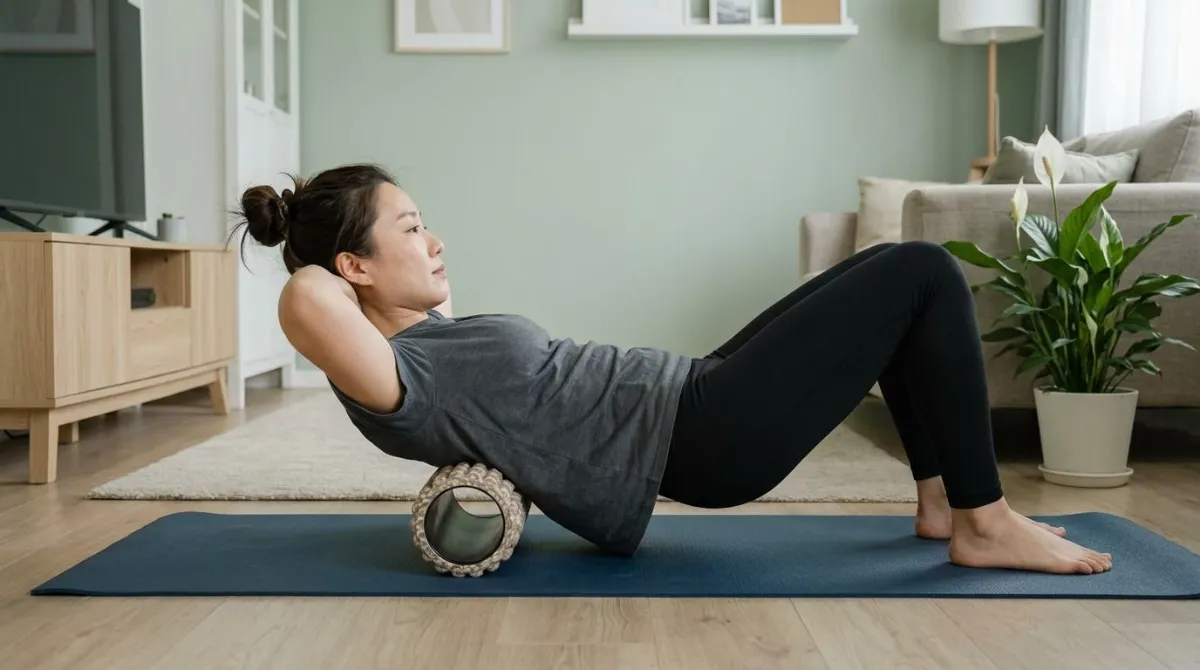
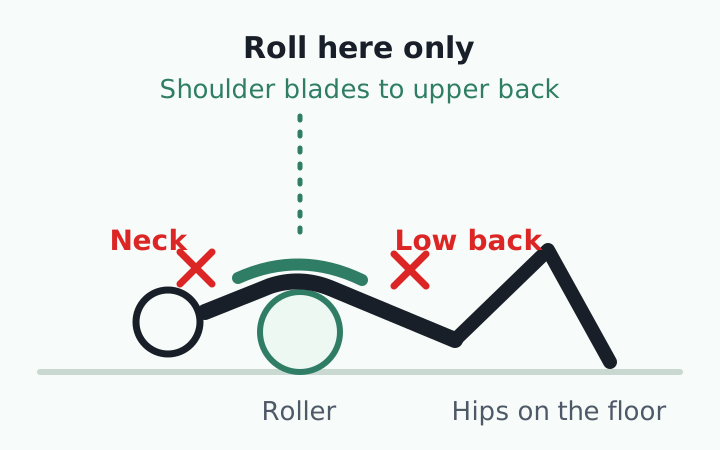
To do foam roller thoracic extension, lay the roller across your back and use it only between the bottom of your shoulder blades and your upper back. Lean back over it for three slow breaths at a few spots, add some slow rolling, and you are done in about three minutes.78 Your neck and low back are not rolling zones.
It helps to set expectations first. Foam rolling has decent evidence for temporarily increasing how far a joint moves.1 Evidence that it changes the shape of a rounded upper back is still weak. In a trial with office workers, a program that included upper back rolling did not change a posture measure more than neck exercises did.6 This guide stays inside what the research supports.
Foam roller thoracic extension at a glance
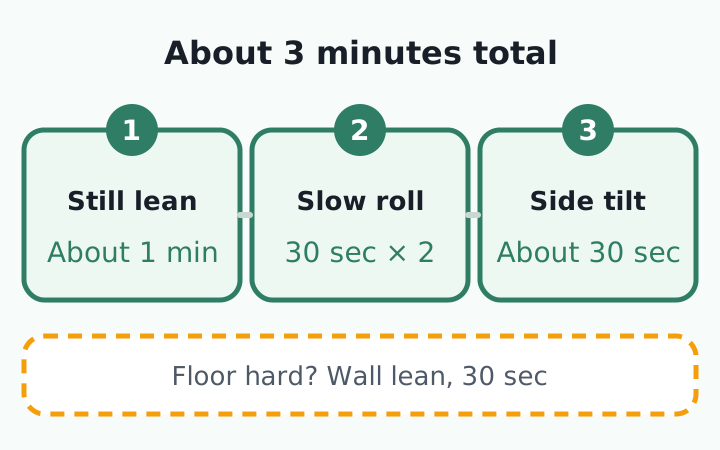
The routine has three floor moves: a still lean, slow rolling, and side-to-side tilts. If getting down to the floor is hard, a wall version replaces all three.
| Step | Move | Roller position | Time |
|---|---|---|---|
| 1 | Still lean | Below, middle, top of shoulder blades | 3 breaths per spot |
| 2 | Slow roll | Below shoulder blades to upper back | 30 sec × 2 |
| 3 | Side tilt | Between shoulder blades | 3 tilts each side |
| 4 | Wall lean (option) | Between your back and a wall | 30 sec |
You do not need long sessions. Ben Kuharik, an exercise specialist at Cleveland Clinic, says you will not need more than three minutes on one muscle area, and a whole foam rolling session should not take more than 10 minutes.9 Harvard Health suggests starting with about 30 to 60 seconds per muscle group, repeated three to five times, at least twice a week.7 The breaths, 30-second rounds, three tilts, and 30-second wall lean in the table are this guide's own picks within that range, not doses tested on the upper back.
Why the thoracic spine matters for desk workers
Your thoracic spine is the 12 vertebrae between your neck and your low back, and your ribs attach to it. After hours at a screen, this section tends to stay curled forward.
We spend a lot of time hunched over at computers, preparing food, changing diapers, etc., and our upper backs are stressed in that position.
Polly de Mille, RN, CSCS, director of sports performance, Hospital for Special Surgery (HSS), 2019
The upper back does not extend very far to begin with. A team led by Stephen Edmondston at Curtin University in Australia measured 40 young adults without symptoms using photo analysis. From normal standing, their thoracic spine extended an average of 8.7 degrees.5 It extended significantly more in unloaded positions, such as lying face down or on hands and knees.5
That is the logic behind lying back over a roller. You use a position where the upper back can extend more easily than when you stand. If you want to understand how sitting rounds the back in the first place, see why your back rounds when you sit.
The 4-move upper back routine, step by step
Use a mat or a rug. Place the roller across your body, bend your knees, and keep your feet flat on the floor.
1. Still lean: three breaths at three spots
- Lie back with the roller just below your shoulder blades and your hips on the floor.
- Support the back of your head with both hands and bring your elbows slightly together. Do not pull on your head.
- Breathe out and slowly lean your upper back over the roller. Keep your abs lightly engaged so your ribs do not flare.
- Stay for three slow breaths, then come back up.
- Lift your hips a little, shift the roller to the middle and then the top of your shoulder blades, and repeat.
If your low back arches along with you, the bend is happening in the wrong place. Keeping your hips down limits that.
2. Slow roll: 30 seconds
- Keep your hands behind your head with your elbows drawn together, pointing at the ceiling.
- Tighten your core and lift your hips slightly off the floor.
- Push with your feet to roll slowly from just below your shoulder blades up to your upper back.
- Roll for 30 seconds, rest, and do one more round.
De Mille at HSS advises stopping just below your shoulder blades as you roll down.8 Going lower moves the roller onto your low back. This is a slow pass over the area, not a hard press into a sore spot.
3. Side tilt
- From the rolling position, rest the roller between your shoulder blades.
- Lean a little more onto the right side of your upper back and roll a few times.
- Repeat on the left.
- Pause at a spot and slowly tilt your upper body right and left, three times each.
De Mille describes leaning more on one side for a few rolls, then the other, and stopping at various spots to side bend slowly.8 Do not let the roller sit on top of a shoulder blade. Harvard Health warns against rolling over bony areas like the shoulder blades.7
4. If the floor is hard, use a wall
If getting up and down from the floor is difficult, do it standing. Dr. Marwa Ahmed, a sports medicine specialist at Massachusetts General Hospital, suggests standing with your back on the roller against a wall.7 Bend and straighten your knees slightly to move the roller up and down your mid back for 30 seconds.
Building better habits: put the roller on the floor right after work, before you shower. Three breaths at three spots is a simple way to close out a day spent leaning toward a screen.
What foam rolling research shows, and what it does not
Most foam rolling studies look at the legs, and they measure range of motion. Here is what the larger reviews found, followed by what we know about the upper back.
| Review | Scope | Finding |
|---|---|---|
| Konrad et al., 20221 | 11 studies, 290 young healthy adults | Rolling for more than 4 weeks gave a moderate gain in range of motion |
| Konrad et al., 20222 | 20 studies | One session matched one session of stretching, up to 20 minutes later |
| Konrad et al., 20243 | 85 studies | Both helped; over 4 weeks or less, only stretching was clearly ahead of control |
| Warneke et al., 20244 | 38 studies, 1,134 people | Not better than other warm-ups such as walking or cycling |
Put together, foam rolling is a reasonable way to loosen up and move more easily for a while.1 It is hard to argue that it beats stretching or a general warm-up.4 The time window studied was short, up to 20 minutes after a single session.2 Results also varied by muscle: range improved for the thighs but not for the calves.1
Studies focused on the upper back are scarce. One randomized trial from Daegu University in South Korea split 32 office workers with forward head posture and neck pain into two groups for six weeks. One group did thoracic extension and shoulder blade exercises, including rolling the upper back on a foam roller. The other did neck exercises and stretching.6
Both groups improved in pain and in craniovertebral angle, a standard measure of how far the head sits forward. The groups differed in pain scores and a breathing measure, but not in craniovertebral angle.6 The design also cannot separate the roller's share from the other exercises.
So this guide does not present the foam roller as a posture fix. Treat it as a first step that loosens a stiff upper back before you move your neck and shoulders. For seated neck moves, see the 90-second neck stretch routine.
Why the neck and low back stay off the roller, and who should skip it
Your mid back is surrounded by ribs, which spread out the roller's pressure. Your neck and low back have no such support. Body weight on a roller there tends to push those joints toward extension.
Harvard Health names rolling over bone as the biggest concern, noting that you cannot iron out bones the way you can soft tissue.7 The bony points at the back of your neck and low back sit just under the skin. That is why this routine stops just below the shoulder blades.8
Skip foam rolling, or talk with a doctor first, if any of these apply. The list follows Harvard Health's guidance; the last item is this guide's own addition.7
- You have advanced osteoporosis
- You have a fracture, an open wound, or a rheumatoid arthritis flare-up
- You have been diagnosed with deep-vein thrombosis
- You have nerve pain, such as burning or tingling
- Your arm or hand goes numb, or you feel a sharp pain, while on the roller
Osteoporosis needs a closer look. The Bone Health & Osteoporosis Foundation tells people with osteoporosis not to flex or bend the spine forward, and notes that gently leaning back reduces stress on the front of the spine.11 So the direction of this routine is not the problem. Putting body weight on a firm roller is a separate question, and Mayo Clinic advises talking with your health care provider before starting an exercise program for osteoporosis.10
If back or neck pain, numbness or tingling in your arms or hands, weakness, or dizziness keeps coming back, see a clinician instead of rolling through it. If a move leaves you sorer the next day, stop that move. This article is general health information and does not replace a diagnosis or treatment. For the signs that need a visit, see when to see a doctor for neck pain.
Choosing a foam roller for your upper back
You do not need a specific brand. Harvard Health describes the typical roller as about six inches across and one to two feet long, and recommends that beginners start with a relatively soft, smooth one.7
| Feature | For the upper back | Why |
|---|---|---|
| Surface | Smooth | Bumps press deeper7 |
| Firmness | Start softer | Less painful; you can move to firmer later7 |
| Length | Wider than your torso | It stays steady when placed crosswise |
A massage ball or lacrosse ball focuses pressure on a much smaller point. Harvard Health mentions a tennis ball for small areas like a tender spot in the shoulder.7 It is not meant to sit directly on your spine with your full weight on it.
Three minutes on the roller is easy. Noticing the slump is harder
Here is the short version. Keep the roller between your shoulder blades and upper back, and about three minutes is enough. There is evidence that it helps you move more easily for a while, but not that it reshapes a rounded back.
The harder part comes after you get off the floor. Once you are back at your desk and focused, your upper back and head drift toward the screen again. That moment is hard to notice on your own. What helps at the desk is a habit of noticing when your head has moved forward and bringing it back.
RightPose AI is a desktop app for Windows and Mac. It uses your laptop or monitor webcam to check your posture at a set interval (every 5 minutes by default) and lets you know on screen when your head is jutting forward. It also sends stretch and stand-up reminders and includes a stretching screen you can follow along with. Camera images are processed on your device and never leave it.
If you're building a better daily routine, pair three evening minutes on the roller with stretch reminders during the day, and start by registering your own good posture.
RightPose AI is not a medical device. It is a habit tool that notices your posture and nudges you to reset and stretch.
FAQ
Is it okay if my back cracks on the foam roller?
The sources reviewed here do not study the cracking sound itself, so there is no reason to chase it. Harvard Health's main concern is pressing on bone, which it says will likely hurt and could lead to injury.7 Avoid bouncing or forcing extra extension, and stop if you feel sharp pain.
Can I foam roll my upper back every day?
Yes, for most people. Harvard Health recommends at least twice a week and suggests daily rolling to really see the benefits.7 In a meta-analysis, range of motion gains were clearer when people kept it up for more than four weeks.1 If you bruise or feel sorer the next day, ease the pressure and take a day off.
Should I foam roll before or after a workout?
If your goal is a short-term boost in range of motion, before a workout is fine. A single round of foam rolling and a single round of stretching produced similar results right after and up to 20 minutes later.2 For desk workers, an evening session after a long day of sitting is often the easiest to stick with.
Does foam rolling help neck pain?
Possibly as part of a broader program. In a six-week trial with office workers, both a program that included upper back rolling and a neck exercise program reduced pain, and pain scores differed between the groups, while posture changes did not.6 The roller's own share cannot be separated from the other exercises. Do not roll the neck itself, and get persistent neck pain checked.
References
- Foam Rolling Training Effects on Range of Motion: A Systematic Review and Meta-Analysis
- A comparison of a single bout of stretching or foam rolling on range of motion in healthy adults
- Static Stretch Training versus Foam Rolling Training Effects on Range of Motion: A Systematic Review and Meta-Analysis
- Foam rolling and stretching do not provide superior acute flexibility and stiffness improvements compared to any other warm-up intervention: A systematic review with meta-analysis
- Thoracic spine extension mobility in young adults: influence of subject position and spinal curvature
- Effects of a combination of scapular stabilization and thoracic extension exercises for office workers with forward head posture on the craniovertebral angle, respiration, pain, and disability: A randomized-controlled trial
- Foam rollers: Inexpensive tools with premium payoffs
- The Right Way to Foam Roll Your Entire Back
- Should You Try Foam Rolling?
- Exercising with osteoporosis: Stay active the safe way
- Protecting Your Spine
This article is for general information only and is not a substitute for medical diagnosis or treatment. If pain persists or worsens, consult a medical professional.