
A lumbar support cushion fills the gap between your lower back and a backrest that does not follow your spine. Three things decide whether it helps: the height (the hollow of your lower back), the thickness (thin enough not to push you forward), and how much seat depth it takes away.173 Whether a cushion reduces back pain is still backed mostly by short experiments.89
This guide covers buying a lumbar cushion, a back cushion or a seat cushion for a chair you already own. For choosing the chair itself, see how to choose an office chair. For each number below, I note who was measured and how.
Lumbar cushion, back cushion, seat cushion: three different jobs
Shops use the names loosely. It is easier to sort them by where they sit between you and the chair.
| Type | Where it goes | Check first |
|---|---|---|
| Lumbar cushion | Between the backrest and the hollow of your lower back | Height, thickness |
| Back cushion | Over the whole backrest | Thickness, seat depth |
| Seat cushion | On the seat | Seated height, firmness |
OSHA says that if your chair has no lumbar support, you can use a rolled-up towel or a removable back support cushion as a temporary fix. What it recommends is a backrest with a height-adjustable lumbar support whose outward curve fits the small of your back.1 Cambridge University Hospitals in the UK also suggests a lumbar roll or small rolled towel at the very bottom of your back.4
Do lumbar cushions reduce back pain? The evidence is thin
A 1979 X-ray study of 38 healthy people found that changing the backrest angle altered the curve of the lower back only a little, while a bigger lumbar support increased it.5 So a cushion does change the shape of your back. Whether that change helps pain is a separate question.
| Study | Who and how | Result |
|---|---|---|
| Williams et al. 19919 | 210 people with back or leg pain, lumbar roll vs flat foam, 24 to 48 hours | Back and leg pain fell in the roll group. Not applicable to stenosis or spondylolisthesis |
| Carcone and Keir 20077 | 30 people, 15 minutes of typing, three pad thicknesses | Preferred the options with lower pressure and less curve (3 cm pad, backrest alone) |
| Grondin et al. 20138 | 28 men, 30 minutes, lumbar pillow | Lumbar angle 2.88 degrees closer to neutral, no change in comfort scores |
| De Carvalho and Callaghan 202311 | 31 adults without symptoms, one chair set up four ways | Lumbar support gave a more neutral back but did not stop sitting-induced pain |
The first study is the most encouraging, and its authors warn that the result does not apply to people with spinal stenosis or spondylolisthesis, whose symptoms a lumbar roll may aggravate.9 The rest are short sittings by healthy people. Diane Grondin and colleagues at the Canadian Memorial Chiropractic College in Toronto concluded:
Angular changes were small and future work is required to determine clinical relevance over the long term.
Diane Grondin et al., Canadian Memorial Chiropractic College, Chiropractic & Manual Therapies, 2013
A Cochrane review of lumbar supports covers braces and corsets, not cushions, but it points the same way. It pooled 7 prevention studies (14,437 people) and 8 treatment studies (1,361 people). In four of the treatment studies (1,170 people), short-term pain relief was little different from no treatment, and many studies were low quality.15 If you are thinking about a back brace, talk it over with your doctor.
You may also see the claim that a cushion lowers disc pressure. The usual source is a sensor placed in one 45-year-old man's lumbar disc for about 24 hours. He read 0.5 MPa standing, 0.46 MPa sitting unsupported and 0.83 MPa sitting in maximum flexion.12 That is one person without a cushion, so it cannot show a cushion effect.
Lumbar cushion height: about 19 cm on average, but people vary
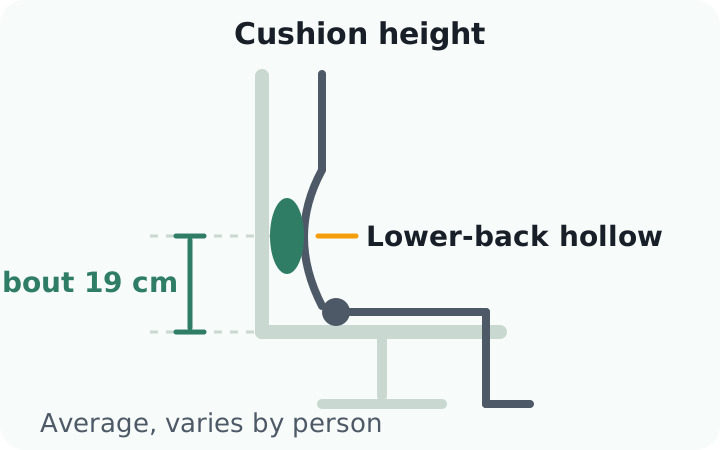
In a study of 123 office workers in Australia (43 men, 80 women), people adjusted the height and depth of a chair's lumbar support on four occasions over five weeks. The average preferred height was 190 mm above the compressed seat, or about 19 cm.6
| Finding | Result (123 office workers) |
|---|---|
| Average preferred height | About 19 cm above the compressed seat |
| Spread of choices | Reached both ends of the adjustment range |
| Higher body mass index | Chose higher supports |
| Recent back pain or discomfort | Pushed the support farther forward |
The authors concluded that fixed-height lumbar supports are unlikely to suit a wide range of users.6 A cushion has an advantage here: you can move it. A strap that holds the position helps you keep the height you found.
Do not over-tune the centimeters. In the X-ray study, moving the support among three vertebral levels made no significant difference in the angles measured.5 Use 19 cm as a starting point and adjust until the bulge rests in your lower-back hollow.
A study at the University of Otago in New Zealand, led by Stuart Horton, photographed 30 healthy men aged 18 to 30. With the backrest at 110 degrees, adding a lumbar roll raised the craniovertebral angle by an average of 2.32 degrees (95% confidence interval 1.31 to 3.33).10 The group was young, male and symptom-free.
Lumbar cushion thickness: people preferred 3 cm
I found no study that sets one correct thickness. These are the values that were tested.
| Thickness | Test | Result |
|---|---|---|
| Three pad sizes | 30 people, 15 minutes typing7 | Biggest pad gave the biggest lumbar curve |
| 3 cm pad | Same test7 | Preferred, along with the backrest alone |
| 9 cm pad | Described by a 2013 paper on that work8 | Held the curve best, but people said it pushed them forward |
Steven Carcone and Peter Keir at York University in Toronto also found that adding a supplementary backrest cut peak pressure on the back by 35% and average pressure by 20%.7 Comfort was rated highest in setups that were not ideal for the spine.
What you can take from this is a direction. Start thin and add thickness only if a gap remains behind your back. If your chair already has an adjustable lumbar support, move that first. Two supports stack their thickness and push you forward.
Seat depth and cushion thickness: your usable seat shrinks
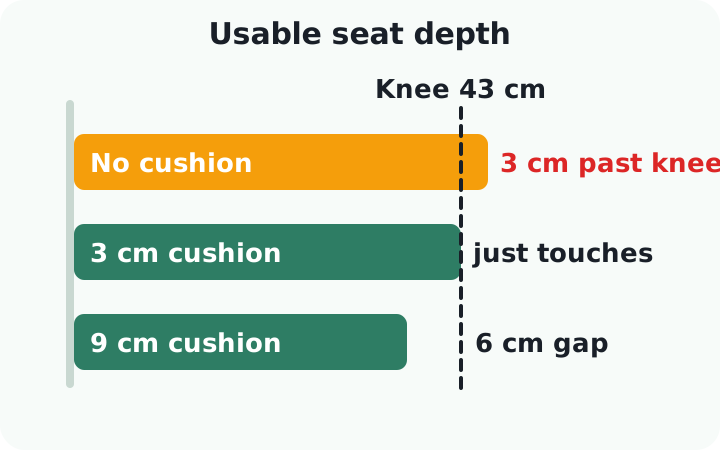
Cornell University's ergonomics notes recommend a seat depth of 16.5 inches (about 42 cm) for fixed seats and 14 to 18.5 inches (about 36 to 47 cm) for adjustable ones. The buttock-to-back-of-knee length of a 5th percentile woman is 17 inches (about 43 cm), and if the seat is deeper than that, the user cannot use the backrest.3
CCOHS gives a quick test: sit back against the backrest and check that a clenched fist (about 5 cm) fits between the front of the seat and your calves.2 A cushion of thickness t moves your back forward by t, so the depth you can actually use shrinks by t. That is plain arithmetic, not a study result. On a seat that is too deep it can relieve pressure behind the knees. On a seat that already fits, it removes thigh support.
| Situation | Effect of a cushion | What to do |
|---|---|---|
| Seat so deep it presses behind the knees | Takes up part of the depth | Add thickness until you have a 5 cm gap |
| Seat already fits | Thick cushion cuts thigh support and pushes you forward | Pick a thin one |
| Seat depth is adjustable | May not be needed | Adjust the seat first |
Seat cushions change height and firmness, not your back
Cornell recommends seat cushioning 1.5 to 2 inches thick (about 3.8 to 5.1 cm), firmer and thicker at the back, softer and thinner at the front. Too much cushioning lets you sink in and limits movement.3 Cambridge University Hospitals likewise says a firm cushion is best and very soft seating can encourage a C-shaped back.4 A seat cushion also raises you by its compressed thickness. If your feet lift off the floor, see when you need a footrest, and for the desk side, monitor, desk and chair height.
| Study | Who | Result |
|---|---|---|
| Roynarin et al. 202413 | 60 office workers, air cushion behind the back, under the buttocks, or none, 1 hour | Posture shifts per hour: 22, 18 and 20. Both positions lowered low back discomfort |
| Channak et al. 202414 | 133 high-risk office workers, air-filled cushion vs placebo pad, 6 months | Low back pain began in 10% vs 59%. Pain in people who already had it did not change |
The second study is the strongest for seat cushions, with caveats. The cushion was an air-filled design built to encourage posture changes, not ordinary foam, and the authors point to posture shifts as the key factor. Two of the authors are also listed as inventors on the cushion's pending patent.14 How often you move may matter more than which cushion you pick.
Checklist before you buy and the day it arrives
- Set the chair height first, with no cushion. Feet flat, no pressure under the thighs
- Slide your hips all the way back against the backrest
- Find the hollow of your lower back with your hand and measure its height above the seat. Compare it with the 19 cm average6
- Place the bulge of the cushion at that height and secure it. If your shoulders roll forward or your belly pushes out, lower it or switch to a thinner one
- With your back against the backrest, check that a fist still fits behind your knees2
- Sit for 30 minutes. Most studies lasted 15 minutes to 1 hour, so longer-term effects are largely unknown713
Add one line to your daily routine: when you sit down after lunch, slide your hips back and check the cushion position. Cushions drift, and a once-a-day reset is an easy habit.
- I checked width, height and thickness in cm on the product page
- It has a strap that fits my backrest
- I measured my seat depth and buttock-to-knee length and subtracted the thickness
- I checked the return policy
If low back pain continues, or you have pain shooting into the leg, numbness or weakness, see a doctor rather than relying on a cushion. If you have been diagnosed with stenosis or spondylolisthesis, ask your doctor before using one.
After the cushion is set, the habit that remains: noticing your head
Here is what the sources show. A cushion changes the shape of your lower back, but the evidence that it reduces pain is short-term. Height, thickness and seat depth are things you can check with your own body, and that is most of the decision.
What remains is the time after you set it up. When you are absorbed in work, your back leaves the cushion and your head drifts toward the screen, and it is hard to notice that yourself. What you can do at your desk is build the habit of noticing when your head has moved forward and bringing it back.
RightPose AI is a desktop app for Windows and Mac that helps with that noticing. Once your chair and cushion are set, you register that upright posture, and the app uses your laptop or monitor webcam to check in at an interval you choose (every 5 minutes by default), alerting you on screen when your head drifts forward; it watches your head, not your lower back. It also nudges you to stand up and stretch at set intervals, which breaks up long stretches against the cushion. Camera images are processed only on your device and never leave it.
If you're building a better daily routine, register your upright posture right after you set your cushion.
RightPose AI is not a medical device. It is a habit tool that notices your posture and nudges you to reset and stretch.
FAQ
Is a lumbar cushion safe if I have a herniated disc?
I found no evidence that any specific cushion helps a disc condition. The 210-patient trial warns that a lumbar roll may aggravate symptoms in people with stenosis or spondylolisthesis.9 If you have a diagnosis, ask the doctor treating you before using one.
Can I keep a lumbar cushion on all day?
I found no study of wearing a lumbar cushion all day. Most experiments above ran from 15 minutes to 1 hour, and the longest, in patients, ran 24 to 48 hours.78139 Even with a good cushion, plan time to stand up and move.
I bought a cushion and my back feels worse. Why?
Usually the height missed the hollow of the lower back or the cushion is thick enough to push you forward. The thickest pad gave the largest curve but not the most comfort in the lab.78 Move it up or down a little and try a thinner one. If pain continues after a few days of adjusting, talk to a doctor.
How does a seat cushion change my desk height?
It raises your seated eye and elbow height by its compressed thickness. Cornell's notes suggest 1.5 to 2 inches (about 3.8 to 5.1 cm).3 Reset the chair height after adding one, and use a footrest if your feet no longer reach the floor.
References
- Computer Workstations eTool: Workstation Components, Chairs
- Office Ergonomics: How to Adjust Office Chairs
- Ergonomics of sitting (DEA 3250 notes)
- Seating and ergonomics
- The influence of backrest inclination and lumbar support on lumbar lordosis
- An empirical study of preferred settings for lumbar support on adjustable office chairs
- Effects of backrest design on biomechanics and comfort during seated work
- The effect of a lumbar support pillow on lumbar posture and comfort during a prolonged seated task
- A comparison of the effects of two sitting postures on back and referred pain
- Changes in head and neck posture using an office chair with and without lumbar roll support
- Effect of office chair design features on lumbar spine posture, muscle activity and perceived pain during prolonged sitting
- New in vivo measurements of pressures in the intervertebral disc in daily life
- Postural shifts and body perceived discomfort during 1-hour sitting when leaning and sitting on an air-filled seat cushion among healthy office workers
- The effectiveness of a dynamic seat cushion in preventing neck and low-back pain among high-risk office workers: a 6-month cluster-randomized controlled trial
- Lumbar supports for the prevention and treatment of low-back pain
This article is for general information only and is not a substitute for medical diagnosis or treatment. If pain persists or worsens, consult a medical professional.