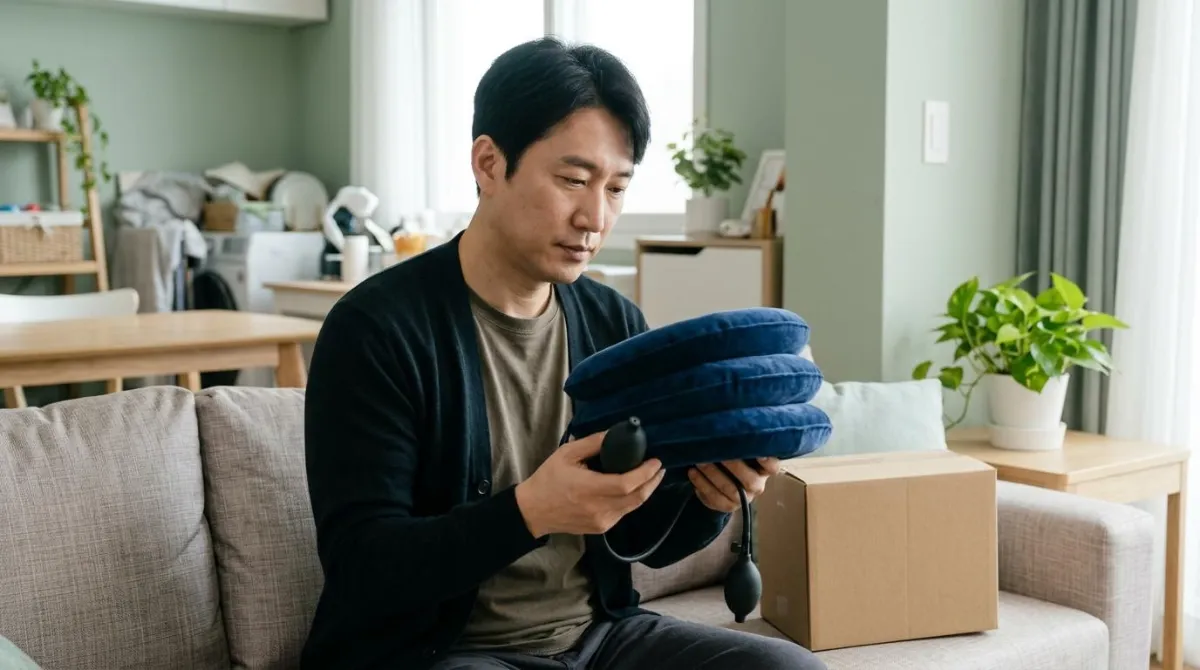
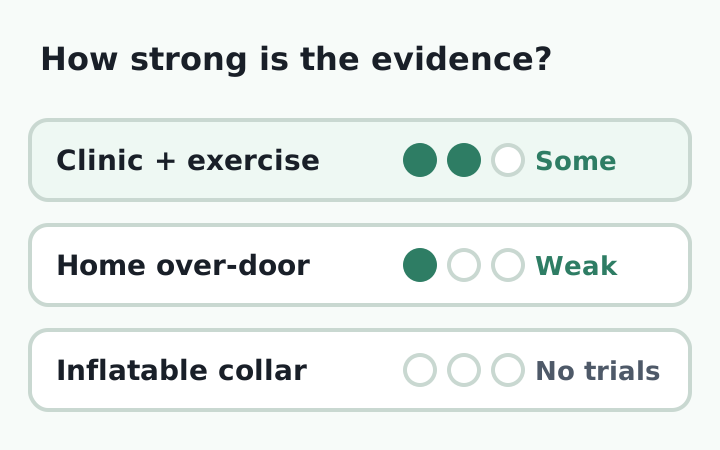
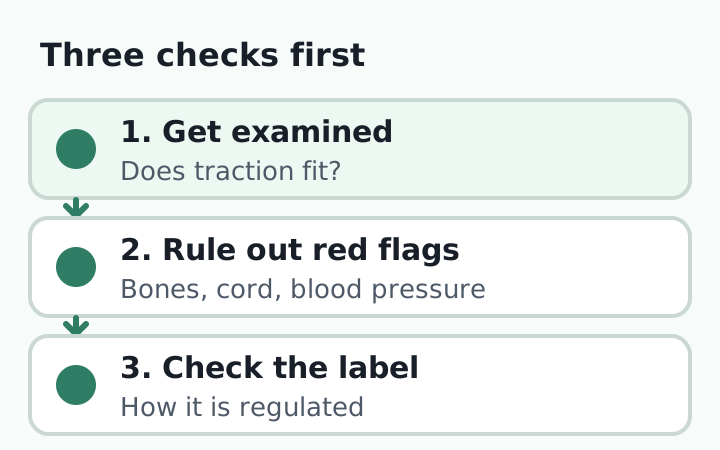
A home neck traction device is a consumer version of cervical traction, a treatment physical therapists use in the clinic. The strongest evidence is for one narrow case: people with a pinched nerve causing arm pain who get machine traction in the clinic along with exercise.23 The evidence for home devices is weaker. Before you buy one, get examined to find out whether traction fits your problem at all.
This guide covers what the research found, how home units differ from clinic traction, who should not use traction, and how to check a device's regulatory status. If you are wondering about disc problems themselves, start with text neck vs. a herniated disc. For straps that pull your shoulders back, see posture correctors and braces.
What a neck traction device does, and how clinic traction differs
In Cochrane's plain-language description, mechanical traction means lying on your back with a head halter under the back of your head (and sometimes the jaw) connected to a machine. The machine pulls with a set weight for a set time, either steadily (continuous) or in on/off cycles (intermittent).1
The usual explanation is that traction opens the space between the vertebrae and stretches the muscles and ligaments around them.1 But StatPearls, written by two authors at Mayo Clinic, notes that no study has accurately described how traction relieves symptoms.6
| Type | How it pulls | What studies show |
|---|---|---|
| Clinic mechanical traction | Lying down; a machine pulls and relaxes in cycles | Started at 5.44 kg (12 lb) and adjusted by a therapist based on symptoms3 |
| Over-the-door traction | Seated; a pulley over a door holds a weight | Started at 3.6 to 5.4 kg (8 to 12 lb); the unit studied maxed out at 9.07 kg (20 lb)3 |
| Manual traction | A clinician holds your head and gently pulls9 | Short-term pain benefit when added to physical therapy in one meta-analysis4 |
| Inflatable neck collar | Worn around the neck and pumped up to push the head upward | No randomized trial of this design alone turned up in our search |
Those forces were set for study participants by therapists who watched how symptoms responded. They are not a dose to copy at home.
Does neck traction work? The research is mixed
The best-known review is Cochrane's 2008 review. It pooled 7 randomized trials with 958 people who had neck pain for more than three months. Only one trial (100 people) had a low risk of bias, and in that trial continuous traction did no better than sham traction for pain or function.1
The authors concluded that the literature could neither support nor refute traction.1 That is not the same as saying traction does nothing. It means there were not enough good trials to decide.
Later reviews narrowed the question to cervical radiculopathy, where a pinched nerve root sends pain down the arm. A 2018 meta-analysis of 5 trials found that adding mechanical traction to physical therapy lowered pain in the short and intermediate term and lowered disability in the intermediate term.4 A 2020 analysis from Italian researchers reached a cooler verdict: pain dropped by a statistically significant amount, but not by enough for patients to notice, and the evidence quality was low.5
| Source | Who was studied | Bottom line |
|---|---|---|
| Cochrane review, 20081 | Chronic neck pain, 7 trials, 958 people | Not enough evidence to support or refute |
| APTA neck pain guideline, 20172 | Chronic neck pain with radiating arm pain | Recommends intermittent mechanical traction combined with other treatments (grade B); continuous traction showed no benefit |
| Romeo et al., 20184 | Radiculopathy, 5 trials | Adding traction to physical therapy lowered pain and disability (some support) |
| Colombo et al., 20205 | Radiculopathy | Statistically significant, but not a clinically meaningful amount |
| American Family Physician, 20167 | Radiculopathy | Several reviews found traction no better than placebo; one newer trial found a benefit |
For patients with chronic neck pain with radiating pain, clinicians should provide mechanical intermittent cervical traction, combined with other interventions such as stretching and strengthening exercise plus cervical and thoracic mobilization/manipulation.
Neck Pain Clinical Practice Guideline, Orthopaedic Section of the American Physical Therapy Association; lead author Peter R. Blanpied, PT, PhD, Professor of Physical Therapy, University of Rhode Island, 2017
Notice the three conditions in that sentence: pain radiating into the arm, intermittent machine traction, and other treatments alongside it.2 It does not cover a generally stiff neck, and it does not cover a device you use alone at home.
Home cervical traction: weaker evidence than clinic traction
One trial compared a home unit with clinic traction head to head. A team led by Julie M. Fritz, a physical therapy researcher at the University of Utah, randomly assigned 86 people with neck pain and signs of radiculopathy to four weeks of exercise only, exercise plus clinic mechanical traction, or exercise plus an over-door unit used daily at home.310
| Comparison | Disability score at 6 months | What it means |
|---|---|---|
| Mechanical traction vs. exercise only | 13.3 points lower | Adding clinic traction helped |
| Mechanical traction vs. over-door | 8.1 points lower | Clinic machine beat the home unit |
| Over-door vs. exercise only | No significant difference | Daily home use looked like exercise alone |
The disability score is a 0 to 100 questionnaire where lower means less trouble with daily life. The home group did worse even though they could keep using the device after the study ended. The researchers also reported that several patients had difficulty with the over-door unit and switched to other treatments.3
This is a single trial of 86 people followed for a year, so it does not settle the question. StatPearls sums up the wider picture: there is no evidence of long-term benefit, although many reports describe temporary relief.6 A device can feel good in the moment without delivering the benefit researchers were looking for.
Neck traction safety: who should not use it
StatPearls starts with a caveat: no scientific report has accurately defined the contraindications to traction. It then lists probable or relative contraindications.6 Not being on this list does not make traction safe for you.
| Category | Conditions listed |
|---|---|
| Bones and ligaments | Osteoporosis, ligament instability, older age |
| Spinal cord and nerves | Myelopathy (spinal cord compression), spinal cord tumor |
| Infection and tumors | Discitis, osteomyelitis, primary or metastatic tumor |
| Blood vessels and general health | Aortic aneurysm, untreated high blood pressure, pregnancy, active peptic ulcer |
| Other | Acute torticollis (a sudden locked, twisted neck), severe anxiety |
Side effects happen too. Cochrane notes that side effects are generally few but can include headache, nausea, fainting, and tissue injury.1 StatPearls advises checking vital signs before and after traction in high-risk patients, especially people with high blood pressure or heart disease.6
Stop and see a doctor if you have numbness, tingling, or weakness in an arm or hand, if fine tasks like buttoning a shirt get clumsy, if your walking feels unsteady, or if symptoms get worse during traction. If you have had neck surgery or a recent neck injury, ask your surgeon or doctor before using any traction device.6
FDA classification and what it does and doesn't mean
In the US, the FDA classifies powered traction equipment, devices that exert therapeutic pulling forces through belts and harnesses, as Class II.8 Nonpowered accessories used with that equipment, such as the pulley, strap, and head halter, are Class I and exempt from premarket notification, the 510(k) review.11
Device class reflects how much regulatory control the FDA applies, not how well a product works. Class I accessories reach the market without a 510(k) submission. So a regulatory label on the box is not evidence that the device will help your neck.
- Find the manufacturer, the model name, and the intended use on the box or product page.
- Compare the marketing with that intended use. Claims to cure a disc problem or reshape your spine go beyond what the trials in this guide measured.
- Check whether the design matches what your clinician recommended. In the trial above, the home unit was an over-door pulley that patients also used during therapy sessions.3
- Have a clinician show you the setup and the starting force before your first session. In that trial, therapists set the starting force and adjusted it to symptoms.3
Questions to ask before trying neck traction
Whether cervical traction makes sense depends on the kind of pain you have. Most traction trials enrolled people whose pain radiated into the arm.24 These questions help you and your clinician decide whether traction fits you, and in what form.
- Is my pain only in the neck, or is it radiculopathy that travels down the arm?
- Are there signs of spinal cord compression, such as clumsy hands or unsteady walking?
- Do I have any condition on the contraindication list?
- Is a home device appropriate for me, and which type?
- What force and how long, and which symptoms mean stop?
- Which exercises should go with traction?
Cleveland Clinic advises talking to your healthcare provider before using an at-home cervical traction device.9 Whatever form traction takes, the guideline recommendation is for traction combined with exercise and other care, not traction alone.2 For signs that neck pain needs a visit, see when to see a doctor for neck pain.
Before buying a device, notice when your head drifts forward
Traction comes from clinical care. Its best evidence is for clinic machine traction combined with other treatment in people with arm pain, and the evidence for home devices is weaker. Some people should avoid it, so an exam comes first.
That leaves the hours no device covers: the long stretch at your desk. Once you are absorbed in work, it is hard to notice your head drifting toward the screen. What you can do at your desk is build the habit of noticing that moment and bringing your head back.
RightPose AI is a desktop app for Windows and Mac built for that moment. It does not pull on your neck. After you register your own upright posture, it uses your webcam to take a quick look at set intervals (every 5 minutes by default) and shows an on-screen alert when it sees forward head posture. Camera images are processed on your device and are not sent off it.
If you're building a better daily routine after checking in with your clinician, start by registering your own upright posture with RightPose AI.
RightPose AI is not a medical device. It is a habit tool that notices your posture and nudges you to reset and stretch.
FAQ
How long should I use a neck traction device each day?
There is no standard time that fits everyone. In the 86-person trial, both clinic and over-door sessions lasted 15 minutes, followed by 2 minutes of rest before getting up.3 Those were study settings chosen by therapists, so get your own time and force from a clinician and follow the device instructions.
Can neck traction fix text neck or forward head posture?
Most traction trials measured pain and disability, and our search found no randomized trial showing that traction changes head position or the curve of the neck.14 For how posture terms differ, see straight neck vs. text neck.
Is neck traction safe with a herniated disc?
It depends on what the disc is doing. The evidence for traction comes from people with a pinched nerve root causing arm pain, while myelopathy, where the spinal cord itself is compressed, is listed as a reason to avoid traction.46 Only an exam can tell which applies to you.
What if I feel dizzy or nauseated during traction?
Stop right away and sit up slowly. Cochrane lists headache, nausea, and fainting among possible side effects.1 If you have high blood pressure or heart disease, vital signs are recommended before and after traction, so talk to your doctor before the next session.6
References
- Mechanical traction for neck pain with or without radiculopathy
- Neck Pain: Revision 2017. Clinical Practice Guidelines Linked to the International Classification of Functioning, Disability and Health From the Orthopaedic Section of the American Physical Therapy Association
- Exercise Only, Exercise With Mechanical Traction, or Exercise With Over-Door Traction for Patients With Cervical Radiculopathy, With or Without Consideration of Status on a Previously Described Subgrouping Rule: A Randomized Clinical Trial
- Cervical Radiculopathy: Effectiveness of Adding Traction to Physical Therapy - A Systematic Review and Meta-Analysis of Randomized Controlled Trials
- Traction Therapy for Cervical Radicular Syndrome is Statistically Significant but not Clinically Relevant for Pain Relief. A Systematic Literature Review with Meta-Analysis and Trial Sequential Analysis
- Cervical Traction
- Nonoperative Management of Cervical Radiculopathy
- 21 CFR 890.5900 Power traction equipment
- Cervical Traction: What It Is, Types & Benefits
- Physical Therapy and Athletic Training Faculty & Staff
- 21 CFR 890.5925 Traction accessory
This article is for general information only and is not a substitute for medical diagnosis or treatment. If pain persists or worsens, consult a medical professional.