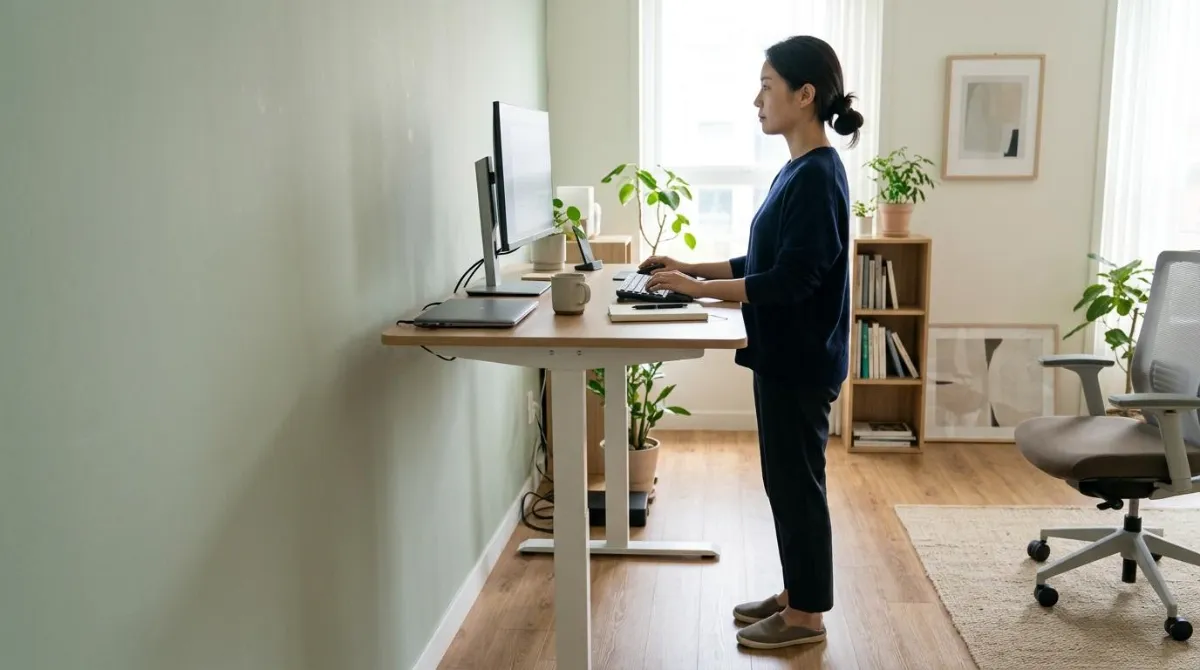
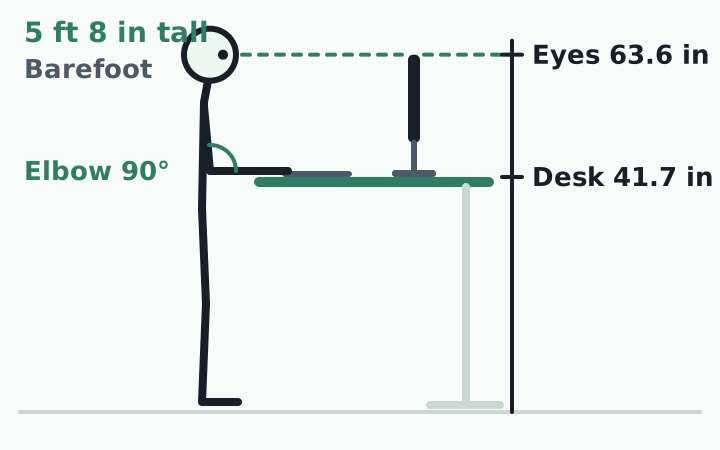
The right standing desk height is the height of your elbows when you stand with them bent 90 degrees. If you are 5'8", that is about 41.7 inches (106 cm) barefoot, or roughly 61% of your height.12 Stand for no more than 30 to 40 minutes at a time, then sit again.79
Standing is not the goal. Long sitting is hard on the body, and so is long standing. A height-adjustable desk simply makes it easy to switch. Below: a height chart with its sources, the sit-stand ratios experts recommend, and how solid the evidence is.
Standing desk height: match your standing elbow height
The Canadian Centre for Occupational Health and Safety (CCOHS) says the desk surface should be at about your standing elbow position, with your arms placed as they are when you sit.2 OSHA's purchasing checklist puts numbers on it.
| Source | Standing height guidance |
|---|---|
| CCOHS (Canada) | Surface at about standing elbow height, elbows bent about 90 degrees2 |
| OSHA (US) | Keyboard at about elbow height, adjustable from 36 to 46.5 in for standing tasks3 |
| CCOHS, by task | Precision work such as writing about 2 in (5 cm) above elbow height, light assembly 2 to 4 in (5 to 10 cm) below4. Keyboard work stays at elbow height, as above |
Set it in four steps.
- Put on the shoes you actually work in. If you use a mat, stand on it.
- Relax your shoulders, let your arms hang, then bend your elbows to about 90 degrees.
- Raise the desk until your hands rest on the keyboard with your forearms roughly parallel to the floor.2
- If your shoulders rise or your wrists bend back, lower it half an inch at a time, then save the height to a memory button.
Standing desk height chart by your height
Most height charts online do not say where their numbers come from. These come from ANSUR II, a 2012 body-measurement survey whose public database covers 4,082 men and 1,986 women in the US Army.1 For seated setup, see our desk and chair height chart.
| Your height | Standing desk height | Standing eye height | Seated desk height |
|---|---|---|---|
| 5'0" | 36.8 in (94 cm) | 56.1 in | 23.1 in |
| 5'2" | 38.1 in (97 cm) | 58.0 in | 23.8 in |
| 5'4" | 39.3 in (100 cm) | 59.8 in | 24.5 in |
| 5'6" | 40.4 in (103 cm) | 61.6 in | 25.2 in |
| 5'8" | 41.7 in (106 cm) | 63.6 in | 26.1 in |
| 5'10" | 43.0 in (109 cm) | 65.4 in | 26.9 in |
| 6'0" | 44.2 in (112 cm) | 67.3 in | 27.6 in |
| 6'2" | 45.6 in (116 cm) | 69.1 in | 28.3 in |
| 6'4" | 47.1 in (120 cm) | 71.1 in | 29.2 in |
All values are from the floor, barefoot, so add shoe and mat thickness. The survey has no direct standing elbow measurement, so we used shoulder height minus shoulder-to-elbow length. Soldiers are younger and fitter than the general public, and the 6'4" row has only 71 people. Use the chart as a starting point.
Three things stand out. First, standing desk height is about 61 to 62% of your height in every row.1 Second, seated and standing desk heights differ by 14 to 18 inches, so a desk needs at least that much travel.
Third, the distance from elbows to eyes is almost the same sitting and standing, within a quarter inch in this data.1 The monitor rides up with the desk, so a screen set while sitting is usually close when you stand. If you lean back in your chair you sit a little lower, so check once that the top of the screen is not above your eyes when standing.2
Sit-stand ratio: what four sources recommend
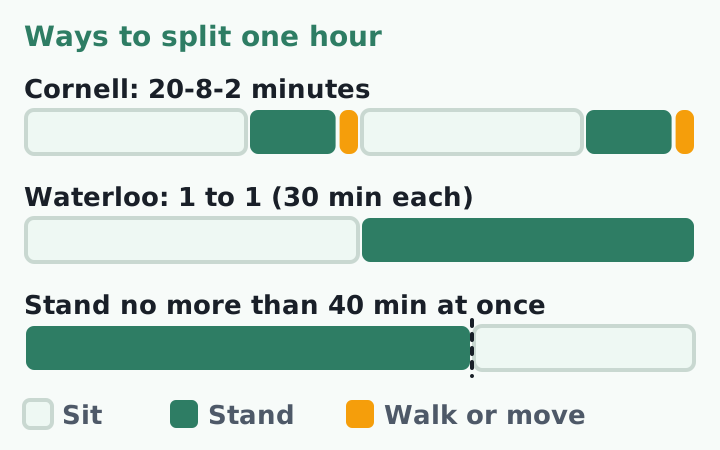
There is no agreed answer on how long to stand. CCOHS notes that recommendations range from sitting an hour and standing five minutes to switching every 20 to 60 minutes, and says the key is to alternate as needed.2 These four are quoted most often.
| Who | Recommendation | Evidence and limits |
|---|---|---|
| Expert statement (UK, 2015) | Build up to 2 hours a day of standing and light walking at work, then toward 4 hours5 | Authors say it rests mostly on observational and short-term studies |
| Jack Callaghan, University of Waterloo | Sit-stand ratio of 1:1 to 1:3; a 2020 position paper starts at 1:167 | Lab studies and risk calculations; ideal ratio still unknown |
| Alan Hedge, Cornell University | Every 20 minutes of sitting, stand for 8 and move for 28 | Expert opinion; says standing alone is not enough |
| Systematic review (2017) | Avoid standing longer than 40 minutes without a break9 | 25 lab studies, 591 participants, short-term only |
The expert statement was commissioned by Public Health England and a UK community interest company and written by eight researchers, including John Buckley (University of Chester) and Alan Hedge (Cornell). They say the evidence is largely observational or short-term and call the numbers initial guidelines.5
Jack Callaghan, a kinesiology professor at Waterloo who studies spine biomechanics, suggested in 2015 standing 30 to 45 minutes of every hour. His group's 2020 position paper says the gold standard ratio is unknown, proposes 1:1 as a starting target, and advises no more than 30 to 40 minutes in one posture.67 The university's news release notes that he helped develop a sit-stand workstation with a furniture company.6
If you wait until you have pain before you change positions, it's too late.
Jack Callaghan, professor of kinesiology, University of Waterloo, Waterloo News, 2015
Put the four side by side and one point repeats: break up any single posture before it reaches 30 to 40 minutes. That matters more than your daily total. If you are new to this, try 30 minutes sitting and 15 to 20 standing, and let your body adapt, as CCOHS advises.2 See also our desk break timing guide.
What happens when you stand too long
Getting rid of the chair only moves the problem. Studies of standing keep pointing to two areas: the low back and the legs.
| Study | Who and how | Result |
|---|---|---|
| Systematic review (2017) | 25 lab studies, 591 people | Low back symptoms after 71 minutes of unbroken standing on average, 42 minutes in people prone to pain9 |
| Waterloo lab study | People with no back pain history stood for 2 hours | Half developed low back pain, per the university's news release6 |
| Curtin University (2018) | 20 adults did 2 hours of standing computer work | Discomfort rose in all body areas, legs swelled, reaction time slowed10 |
| UK Biobank analysis (2024) | 83,013 adults wore activity trackers, followed about 7 years | Above 2 hours of standing a day, each extra 30 minutes went with 11% higher risk of orthostatic circulatory disease12 |
The last study, from the University of Sydney, found that standing time was not linked to heart disease or stroke. It was linked to circulation problems such as varicose veins and low blood pressure on standing. Sitting more than 10 hours a day raised both risks.12 The authors concluded that prescribing more standing may not lower cardiovascular risk.
You may also see the claim that standing jobs double heart disease risk. It comes from a 12-year Canadian study of 7,320 workers that compared mostly-standing occupations with mostly-sitting ones.11 Office workers who can sit whenever they want are in a different situation.
If pain, numbness, marked swelling, or dizziness keeps returning when you stand, do not try to solve it by standing more. See a doctor. The chart here is for setting up a desk and is not a diagnosis.
Are standing desks worth it? What is proven and what is not
What is proven is that people sit less. A 2018 Cochrane review pooled 34 studies with 3,397 participants. Sit-stand desks cut sitting at work by about 100 minutes a day in the first three months and 57 minutes a day at 3 to 12 months. The reviewers rated the evidence low quality and found nothing on longer periods.13
A later randomized trial followed 756 office workers at UK local councils for a year. A program to reduce sitting cut it by 22 minutes a day. The same program plus a height-adjustable desk cut it by 64 minutes, about three times as much.14
The evidence on pain is thinner. A meta-analysis of eight studies found a small drop in low back discomfort among people without pain, and noted a lack of studies in people who already have back pain.15 A 2019 review of 53 studies concluded that sit-stand desks change behavior but only mildly affect health outcomes, least of all productivity.16
Many desks end up parked at sitting height. In Hedge's field studies users stood 15 minutes or less per day in total, and CCOHS notes that some users return to mostly sitting after an initial trial period.82
Before you buy a standing desk: four specs to check
This guide does not rank products. Whatever you are comparing, check these four specs first. They decide whether the desk fits your body.
| Spec | What to check | Why |
|---|---|---|
| Lowest height | Does it go down to your seated desk height in the chart? | The lowest setting can still be too high for shorter users. Check if the figure includes the desktop thickness |
| Highest height | Does it reach your standing height plus shoes and mat? | OSHA lists 36 to 46.5 in as the keyboard range for standing tasks3 |
| Memory presets | Can you recall sit and stand heights with one button? | Some users drift back to mostly sitting, so switching should take no effort2 |
| Stability and cables | Is the screen steady when you type at full height? Is there cable slack? | CCOHS: cables and storage should not make adjusting difficult2 |
If the lowest setting is still above your seated height, raise your chair and support your feet with a footrest.
If you share the desk, or the screen is off when you stand, a monitor arm or riser lets you move the screen on its own. Hedge notes that a screen left too low at standing height makes you bend your neck, which is what happens with a laptop used alone.8
Pick tasks that are easy to do standing, such as calls, video meetings, or email. Your posture then changes with your work, no timer needed.
If a standing desk kicked off your new routine, save your sitting and standing heights to its memory buttons, if it has them. The quicker the switch, the more often you'll make it.
The desk moves, but noticing is still up to you
To sum up: set the standing height to your bent elbow, about 61% of your height, and break up any posture within 30 to 40 minutes. What a height-adjustable desk reliably does is reduce sitting time.
One problem remains. Absorbed in work, you miss the moment to raise the desk, and your head drifts toward the screen whether you sit or stand. That is hard to notice yourself. So the useful desk habit is noticing when your head has moved forward or when it is time to get up, and resetting.
RightPose AI is a desktop app for Windows and Mac. It has reminders at set intervals to stand up and stretch, which you can use as your cue to raise the desk. It also uses your laptop or monitor webcam to check your posture briefly at an interval you choose (5 minutes by default) and shows an on-screen alert when your head has drifted forward. Camera images are processed on your device only.
Add a posture check to your sit-stand routine. It starts with registering your good posture.
RightPose AI is not a medical device. It is a habit tool that notices your posture and nudges you to reset and stretch.
FAQ
Do you burn more calories at a standing desk?
A few, but fewer than most people expect. A meta-analysis of 46 studies with 1,184 participants found that standing burns 0.15 kcal per minute more than sitting. For a 143 lb (65 kg) person, six hours of standing a day adds about 54 kcal.17 A Harvard Health article citing a measurement study put it at 88 calories an hour standing versus 80 sitting, while walking burned 210.18
Do I need an anti-fatigue mat or a footrest at a standing desk?
CCOHS suggests supportive footwear, an anti-fatigue mat where appropriate, and a footrest so you can shift your weight from leg to leg.2 They are comfort aids, not a license to stand longer. In a lab study of 20 adults, being told to rest one foot on a footrest in fixed 5-minute turns did not reduce discomfort over two hours of standing.19
Will a standing desk help my back pain?
It is not known. The pooled result showing less low back discomfort came from people without pain, and studies in people with existing back pain are lacking.15 Standing also triggers back pain in some people. In Waterloo research, people who developed back pain while standing were three times more likely to have chronic back problems later.6 If pain persists, see a doctor.
What if I can't get a standing desk?
Changing position often matters more than the desk. Hedge's advice is to take a posture break about every 20 to 30 minutes and stand and move for a couple of minutes, and he adds that just walking around is sufficient.8 Taking calls or short meetings on your feet is an easy place to start.
Is a fixed-height standing desk okay?
For cutting sitting time, the Cochrane review found no significant difference between standing-only desks and sit-stand desks.13 But given what long standing does to the back and legs, you need a way to sit. OSHA's checklist calls adjustability between seated and standing heights desirable.3 CCOHS says a seat should be provided even for standing-only work, so keep a tall stool at a fixed desk.4
References
- 2012 US Army Anthropometric Working Databases (ANSUR II), public data files
- Office Ergonomics - Sit/Stand Desk
- Computer Workstations eTool: Checklists - Purchasing Guide
- Working in a Standing Position - Basic Information
- The sedentary office: an expert statement on the growing case for change towards better health and productivity
- How long should you stand - rather than sit - at your work station?
- Sit-Stand Workstations - Are They Equal to the Hype?
- Sitting and Standing at Work
- Associations of prolonged standing with musculoskeletal symptoms - A systematic review of laboratory studies
- A detailed description of the short-term musculoskeletal and cognitive effects of prolonged standing for office computer work
- The Relationship Between Occupational Standing and Sitting and Incident Heart Disease Over a 12-Year Period in Ontario, Canada
- Device-measured stationary behaviour and cardiovascular and orthostatic circulatory disease incidence
- Workplace interventions for reducing sitting at work
- Effectiveness of an intervention for reducing sitting time and improving health in office workers: three arm cluster randomised controlled trial
- Sit-stand workstations and impact on low back discomfort: a systematic review and meta-analysis
- The effect of sit-stand desks on office worker behavioral and health outcomes: A scoping review
- Differences of energy expenditure while sitting versus standing: A systematic review and meta-analysis
- The truth behind standing desks
- Musculoskeletal and Cognitive Effects of a Movement Intervention During Prolonged Standing for Office Work
This article is for general information only and is not a substitute for medical diagnosis or treatment. If pain persists or worsens, consult a medical professional.